Taijiquan Footwork Compared: Chen, Yang, Wu, Wu-Hao and Sun Styles
Key Takeaways
- Footwork terminology overlaps across styles while the mechanics behind it differ: a stance name does not guarantee a foot position, and a measurement from one routine does not apply to every style.
- Each tradition organises the transition between postures differently — advance, turn, and connection — so the useful question is how each style does it, not which style does it correctly.
- Classical writings, lineage publications, formal standards, secondary references and modern teaching explanations are kept distinct, and disagreements are preserved when the sources do not support one conclusion.
Why stepping mechanics, lineage differences, and source evidence matter more than a single “correct” stance.
Why Taiji Footwork Is Harder to Compare Than It Looks
Open two books on Taijiquan and compare their descriptions of a bow stance, a turning foot, or the angle of the rear foot. You may find that the terminology overlaps while the technical explanations differ.
One source may emphasise a heel-first landing. Another may describe a scraping step. A third may explain turning through the waist and hip rather than through an isolated movement of the foot.
These differences are not necessarily contradictions. They may reflect different styles, different teaching traditions, different routines, or different levels of technical description.
The difficulty is that Taijiquan is often discussed as though it were a single, uniform system of movement. A stance name is treated as if it guarantees a particular foot position. A teaching metaphor becomes a universal rule. A measurement taken from one routine is repeated as though it applies to every style.
Footwork deserves a more careful approach.
This research examines five major Taijiquan traditions: Chen, Yang, Wu (the Wu Jianquan lineage), Wu/Hao, and Sun. Rather than asking which style has the “correct” footwork, it asks a more useful question:
How does each tradition organise the movement between one posture and the next, and what evidence supports the descriptions we commonly encounter?
Five Styles, Five Distinctive Starting Points
The following are broad points of entry into the comparison, not complete definitions of each style. Individual lineages and teaching systems may differ.
Chen style: stepping as a continuous cycle
Chen-style large-frame teaching includes the cabu (擦步, scraping step), in which the moving foot travels close to the ground. Outward swings and inward tucks can be coordinated with the style’s silk-reeling vocabulary.
The important question is not simply where the foot lands, but how the step connects with the supporting leg, the waist, and the next movement.
Yang style: landing, weight transfer, and turning
Yang-style instructional material often describes a light, heel-first landing during an advance. Turning techniques are also discussed through terms such as zhanjiao (展脚), koujiao (扣脚), and ningjiao (拧脚).
However, Yang-style sources do not always agree on how a supporting foot should rotate. Those differences need to be examined as distinct teaching accounts rather than reduced to one universal instruction.
Wu style: compact steps and parallel-foot alignment
In the Wu Jianquan lineage, the chuanzibu (川字步, river-character step) describes a characteristic relationship between the feet, which are generally presented as parallel rather than widely splayed.
Some Wu-style teaching accounts also emphasise small-range hip rotation and the coordination of the supporting and moving legs. The precise description depends on the source and transmission being discussed.
Wu/Hao style: follow-steps and compact transitions
Wu/Hao-style materials describe a distinctive vocabulary of stepping and stance categories, including the genbu (跟步, follow-step) and shizhuan bu (实转步, rotation step).
In one documented transmission, a particular rotation method is described using two pivot axes. That account should remain attached to the transmission in which it appears; it should not automatically be attributed to every Wu/Hao practitioner.
Sun style: small steps and immediate follow-through
Sun-style stepping is strongly associated in instructional accounts with the paired principles jinbu bi gen (进步必跟, the rear foot follows on advancing) and tuibu bi che (退步必撤, the front foot withdraws on retreat).
These descriptions draw attention to the connection between successive movements. A step is not merely a final stance; it is part of a continuing sequence.
Three Questions Help Make the Comparison More Precise
Instead of comparing photographs of finished postures alone, this research examines three aspects of dynamic stepping.
1. How does weight transfer during an advance?
Which leg supports the body before the other foot moves? How does the empty leg travel? Which part of the foot touches down first? How does the body settle after contact?
2. How does the foot coordinate with turning?
Does a source describe a heel pivot, a ball-of-foot pivot, a small foot adjustment, or rotation coordinated through the waist and hip? Are these descriptions from the same lineage, or do they represent different accounts?
3. How does one step connect to the next?
Some teaching systems emphasise drawing the feet closer together. Others describe a follow-step, a scraping cycle, or a compact advance-and-retreat rhythm. The same translated term may not indicate the same mechanics in every tradition.
These questions provide a shared framework for comparison without assuming that all five styles use identical movement rules.
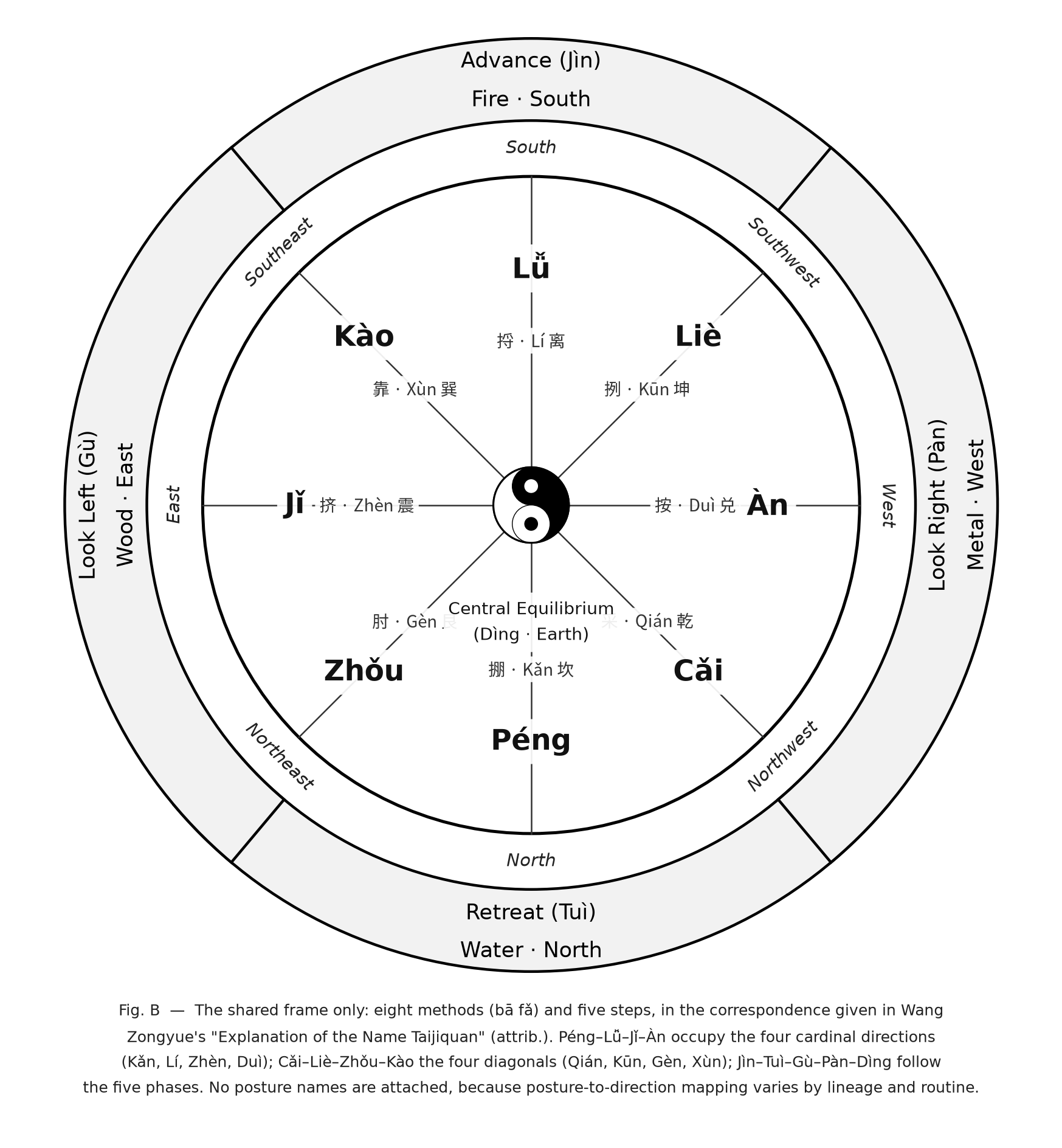
What the Evidence Can—and Cannot—Tell Us
A technical description is not automatically a universal prescription. A measurement from a particular routine does not establish an ideal angle for every practitioner. A statement from one lineage holder does not necessarily describe every branch of a style.
For that reason, the full study distinguishes classical writings, lineage publications, formal standards, secondary references, and modern teaching explanations. It also preserves disagreements when the available sources do not support a single conclusion.
This distinction matters especially when a description of movement is used to make claims about knee safety, force generation, or biomechanical efficiency. Those claims require evidence beyond the description of a foot position. This study does not infer clinical outcomes from posture descriptions alone.
The aim is not to rank the five styles or prescribe a universal method. It is to make their differences easier to understand, while showing readers how to distinguish a documented technique from a teaching interpretation or an unresolved claim.
Explore the Full Comparative Study
The complete research article examines each style in greater detail and compares how its footwork operates during advancing, turning, and connecting movements.
The same distinction comes up in practice, not just in print. In a members’ discussion on cross-style footwork terminology, several practitioners describe arriving at the same confusion from the floor — a stance name borrowed across lineages, a measurement quoted without the routine it came from.
The member edition includes:
- Detailed, style-by-style analysis of stepping mechanics.
- Comparative tables covering stance vocabulary, foot placement, turning, and movement transitions.
- Documented disagreements within and between traditions.
- Numerical parameters tied to their specific routines and sources.
- An evidence framework that distinguishes verified statements from secondary accounts and unresolved questions.
The central finding is simple: Taijiquan traditions share useful concepts, but shared concepts do not make their stepping mechanics interchangeable. Understanding the difference requires attention to movement, terminology, lineage, and evidence—not just the final shape of a stance.
Continue reading — members only
The full study compares how Chén, Yáng, Wú, Wǔ/Hao and Sūn styles actually transfer weight and pivot, including where the sources disagree. Membership also unlocks every structured program and the members-only video library.
Unlock with membershipAlready a member?
Master Gu
15th-generation Wudang lineage holder guiding the philosophical framework.
View all articles →