Dantian Breathing: How It Actually Works, Step by Step
Key Takeaways
- There are two gears, not one. Natural abdominal breathing (shun fu shi hu xi) comes first. Reverse abdominal breathing (ni fu shi hu xi) is a later gear with entry conditions. The order is a safety system, not a style preference.
- The sinking sensation is coordination, not air. What the old texts call qi chen dantian is a felt heaviness in the lower abdomen produced by a descended diaphragm, a relaxed pelvic floor, and settled posture working together. Nothing travels down your torso.
- Chest assist is normal at the beginning. The reason most people stall is not lack of sensitivity — it is that the shoulders and chest quietly do part of the work while the belly moves enough to look correct.
- Belly movement is a sign, not the goal. If you have to push the abdomen out with muscle, you are performing the breath, not breathing it.
- The tradition's seasonal emphasis is about gathering, not health outcomes. Autumn practice in the classical cultivation language means storage. The lower-abdomen focus is the attentional form of that storage — which is why the method pairs with standing practice and slow forms instead of replacing them.
Direct answer — read this first. Dantian breathing is the name of a training path in tai chi chuan and qigong, not a single technique. The mechanism in one line: you are not sending air or energy down — you are teaching your whole posture to settle around a descending diaphragm, and the lower belly is simply where that settling is felt. If you have never practiced it, start with the first supine drill in Path One below, before you read anything else.
The Name and What It Refers To
Students come to me wanting “the dantian breathing technique.” It does not exist in that form. What exists is a path — a sequence of postures, sensations, and conditions that a body moves through over months. The name points at where attention rests and what the posture is doing while it rests there. It does not name a move you can pick up in an afternoon.
The lower dan tian is the region the attention settles into, roughly the lower abdomen below the navel — the lower dan tian. I will not re-teach its location and activation here; I have written about that separately, and one recap paragraph at the end of this section links you to it. What matters for this article is the grammar around the name.
Chinese cultivation language uses a shun and ni pairing. Shun fu shi hu xi is the natural or forward pattern: the abdomen expands as you inhale, settles as you exhale. Ni fu shi hu xi is the reverse pattern: the abdomen draws in as you inhale, releases as you exhale. In the wider grammar of Chinese internal practice, the natural sequence is the one you build first, and the reversed sequence is the advanced, conditional one. Teachers rarely spell this out to beginners. They simply start you on the natural pattern and let the reverse appear much later, if it appears at all.
Skipping the order is the single most common modern error. A reader who finds a page that labels both as “techniques” has no way to see that one is a foundation and the other is a gate that opens under conditions. The condition is stability. Natural first, reverse later — the order is not a style preference, it is the safety system.
When the classics say “qi sinks to the dantian,” they are naming a body state, not describing a substance. Chinese-speaking students inherit the feel of the phrase from their teachers and their teachers’ hands. In English the phrase usually gets mistranslated into physics — push the air down — or into fantasy — move the energy. The classical commentaries treat it as neither. It is a named state that the whole posture arrives at.
If you want the location and activation groundwork, read the companion piece on qi chen dantian. This article is about the path that gets you there.
The Mechanism: Why Belly Expansion Is the Visible Sign
Here is the plain machinery. Your diaphragm is a dome of muscle sitting under your lungs. When it contracts on the inhale, it descends. That descent pushes downward on the contents of your abdomen, and because the abdomen has some give, the front wall moves outward. Belly expansion is the visible sign of a diaphragm that is doing the primary work.
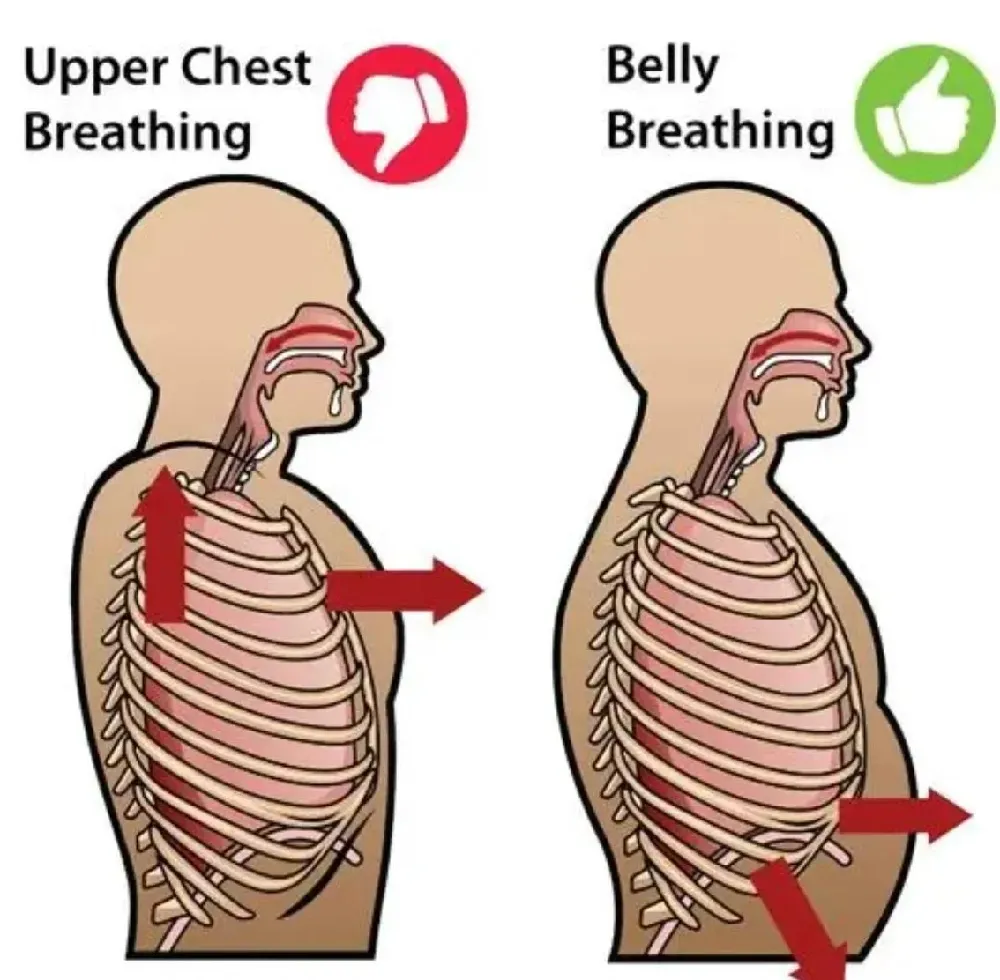
When the diaphragm is the prime mover, the chest and shoulders stay relatively quiet. When it is not, the accessory muscles of the neck and upper chest step in. You can breathe in a way that looks low and still be running the pattern mostly from above. This is why I audit mechanics rather than appearance.
Now the settling. As the diaphragm descends, the pelvic floor and the lower abdomen respond. In a settled posture — feet grounded, spine relaxed but not collapsed, weight even — that response registers as a heaviness low in the belly. Not a push. Not a ball of warmth traveling downward. A heaviness that appears when the parts coordinate and vanishes when they do not.
I run a simple effort audit on my own students — checking whether the breath keeps its settled, structural quality once the muscular effort that should not be there is removed. Two questions. Does the breath still work if I remove all effort from the belly wall? Does the chest stay out of the inhale? If both answers are yes, the diaphragm is leading. If either is no, the pattern is partial, no matter how the belly looks.
The reason the tradition centers attention on the lower abdomen rather than on the chest is not mystic. It is gathering. Autumn practice in the classical texts is storage, not expenditure. The lower-abdomen focus is the attentional form of that storage — a way of keeping the mind where the body is settling instead of scattering it upward into effort. That is exactly why the method pairs with standing practice and slow forms. It is a companion to those practices. It does not replace them.
Path One: Natural Abdominal Breathing Step by Step
Three drills. Do not move to the next until the current one passes the ease test in the self-check section. Expect weeks, not days.
Drill 1 — Supine, hands on the abdomen. Lie on your back, knees bent, feet flat. One hand below the navel, one on the upper chest for reference only. Breathe through the nose. Let the lower hand ride outward on the inhale and settle on the exhale. The upper hand should stay nearly still. If the upper hand moves first, the pattern is running from the chest — do not correct it by force. Reduce the breath size until the chest goes quiet, then let the belly move a little more. Five minutes is enough at the start. I have heard “I puffed my belly and felt silly” from more students than I can count. Feeling silly is not a signal that you are doing it wrong. It is a signal that a new body pattern has not yet become ordinary.
Drill 2 — Seated. Sit on the front third of a firm chair, feet flat, spine tall, hands resting low on the abdomen. Same intention as Drill 1, now against gravity. The abdomen still expands on the inhale and settles on the exhale. Watch the lower back — it should not arch to fake the descent. If the belly movement now needs muscular effort, you have moved too early. Go back to supine.
Drill 3 — Wuji stance. Stand with feet parallel, about shoulder-width, knees soft, arms hanging. This is wuji — the neutral posture before any form begins. Here the breath meets gravity head-on. Same natural pattern. The lower belly expands on the inhale, settles on the exhale, and the whole posture stays quiet. This is the drill that matters most, because it is the posture you will actually stand and move in. Once the pattern survives three to five minutes of wuji without the chest assisting, you have the foundation. Everything else builds on it.
A note on repetition. Repeating this simple correct movement a thousand times is the advanced practice. It looks like nothing. It is the whole thing. A thousand students, a thousand paths, but every one of them walks this same first stretch of road.
Path Two: The Sinking Sensation
Once natural breathing is stable in wuji stance, you begin to notice something that was already there. A heaviness settles low in the abdomen at the end of the exhale, and it persists a moment into the next inhale before dissolving. That is the felt side of qi chen dantian.
I want to be precise, because this is where English-language practice goes wrong in two directions at once. The sinking is not moved air. Nothing is pushed down your torso. The sinking is also not moved energy. There is no bubble to chase. It is a coordination event: descended diaphragm, relaxed pelvic floor, settled posture, quiet attention. When those four align, the lower abdomen reports weight. When any of them is missing, it reports nothing, and no amount of concentration will manufacture it.
The classical anchor is the instruction to let qi sink to the dantian — a canonical line in tai chi chuan and qigong classics. The physical bridge is the muscle coordination above. The instruction and the mechanics describe the same event from two sides, one in the language of practice and one in the language of the body. You do not need to choose between them. You need the posture that lets the event happen.
If the mechanics of locating and settling into that region are still unclear to you, that is the companion article’s job — read Dantian in Tai Chi and Qigong: What It Is & How to Activate It and come back. Here, the point is only this: the sinking is trainable, it arrives on its own schedule, and it is not something you produce by trying harder.
The Reverse Pattern: A Later Gear
Now the gate. Reverse abdominal breathing (ni fu shi hu xi) is real and it has a place. It also has entry conditions, and I will hold you at the door until you meet them.
Do not attempt the reverse pattern until you have four to six weeks of relaxed natural breathing in stance, with no breath-holding under gentle pressure. That is the floor, not the target. If a partner pressing lightly on your abdomen during a slow form makes you grip or hold, you are not ready. Reverse breathing under tension is a way to teach yourself to strain.
When the conditions are met, the pattern is introduced under supervision, not from a page. Two intro drills belong here as a preview only. First, in wuji stance, on the exhale let the lower abdomen draw gently inward while the breath leaves, then release on the inhale. Second, the same action while a teacher’s hand rests on your lower back to confirm you are not locking the pelvis. Both are coordination, not force.
Stop conditions, stated plainly: stop if you feel pressure in the head, if you cannot keep the chest quiet, if the exhale becomes a push, or if you find yourself holding your breath to make the movement happen. Stop and return to natural breathing for a week. The reverse pattern is a maybe-later for this article. It is explicitly not today’s work.
I keep writing about reverse breathing because it earns its place — but only after the natural path is stable. The classical sequence, cultivate first and then reverse, is a safety rule wearing the clothes of tradition.
Self-Check: 6 Failure Modes and Fixes
Run this after any practice session. Honest answers only.
1. Chest assist. The shoulders or chest rise on the inhale before the belly moves. This is the most common stall, and it hides well. Fix: return to supine and rebuild. Do not progress to standing while the chest is helping.
2. Belly forcing. The abdomen movement needs muscular effort. You are performing the breath, not breathing it. Fix: cut session length in half and make the breath smaller until effort disappears.
3. Breath holding. You catch yourself gripping or pausing at the top or bottom of the breath, especially under any pressure. Fix: shorten every session and add a normal walking minute between sets.
4. Sinking as chasing. You are hunting the heaviness, tightening to find it. Fix: stop aiming. The sinking arrives when the posture is settled and disappears when you pursue it.
5. Dizziness. Tingling, lightheadedness, or a floating feeling during practice. This is a side effect, not a milestone. Fix: stop, walk normally, breathe without counting. If it returns, drop the practice length and check your posture.
6. Over-long sessions. Twenty minutes of a partial pattern drills the error deeper. Fix: five clean minutes beats twenty sloppy ones, every time.
Practice Progression Table
| Weeks | Daily minutes | Posture context | Success criterion |
|---|---|---|---|
| 1–2 | 5 | Supine, knees bent | Lower hand moves, upper hand nearly still |
| 3–4 | 5–8 | Seated, then short supine | Belly moves without muscular push; lower back stays neutral |
| 5–8 | 8–12 | Wuji stance, standing | Chest quiet through 3–5 minutes in wuji |
| 9–12 | 10–15 | Wuji plus slow form | Sinking sensation appears at end of exhale without chasing |
| 13+ | 15–20 | Standing and form, supervised | Natural pattern stable; reverse pattern considered only if conditions met |
Move at the pace the table’s success criterion allows, not the pace the calendar suggests. The table describes a body, not a schedule.
Autumn Timing: Gathering Practice
In the classical seasonal language of Chinese cultivation, autumn carries a specific meaning: gathering. The Su Wen, in its seasonal passages, describes autumn as a time of collecting — of storing rather than spending. That is why breathing-centric practice is traditionally emphasized in this season.
I want to be careful here, because this is a cultural point, not a medical one. I am not telling you autumn breathing improves anything about your body. I am telling you that the tradition frames the season as one of storage, and that the lower-abdomen focus of dantian breathing is the attentional shape of storage — attention kept low, movement kept slow, effort kept small. That framing is the reason the practice pairs naturally with standing meditation (zhan zhuang) and slow forms at this time of year. It gathers instead of scattering.
If a seasonal hook makes you practice more steadily, take it. If it makes you expect a feeling, put it down. Winter training grounds in Haidian taught me that the season is a context, never a promise. Breath visible in the cold air, movements slow and deliberate — the season asks you to settle, and settling is the whole method.
What This Page Does Not Cover
This page owns the dantian breathing mechanism and the practice progression. Two adjacent questions are answered elsewhere on this site, deliberately:
- How breath coordinates with movement in tai chi generally — the synchronisation doctrine, the breathing patterns used in form practice, and how to stop thinking about the breath — is owned by How to Breathe in Tai Chi. Read it after the natural pattern is stable.
- What the dantian is and how to locate and activate it — the anatomy, the classical framing, and the activation drills — is owned by Dantian in Tai Chi and Qigong: What It Is & How to Activate It. Read it before Path Two if the region is still unclear to you.
A third related practice, the six healing sounds of Baduanjin breathing, applies breath regulation to organ-sequenced movement — a different intent from the standing, gathering work described here.
FAQ
What is dantian breathing in one sentence? It is a training path in which the diaphragm leads the breath and the whole posture settles around it, with attention resting low in the abdomen where that settling is felt.
How long does it take to learn natural abdominal breathing? For most students, three to eight weeks of short daily practice to get the chest quiet in standing, and longer to make it stable under movement. Faster is usually a sign the chest is still helping.
What does sinking qi to the dantian actually feel like physically? A heaviness low in the abdomen at the end of the exhale, produced by the descended diaphragm, a relaxed pelvic floor, and settled posture coordinating. It is not air moving and not energy moving.
Should beginners try reverse abdominal breathing? No. It is a later gear with entry conditions, and it is introduced under supervision after the natural pattern is stable — commonly four to six weeks at minimum, often longer.
Why does my chest take over when I try to breathe low? Because the diaphragm has not yet become the prime mover, so the accessory muscles of the neck and chest do part of the work. Fix it by reducing the breath and rebuilding supine, not by forcing the belly.
Is dantian breathing the same as meditation breathing? They overlap in posture and quietness, but dantian breathing is tied to a martial and cultivation framework — wuji stance, slow forms, zhan zhuang — not only to sitting stillness. The attention and the conditions differ.
How does dantian breathing connect to standing meditation (zhan zhuang)? They train the same thing from two angles. Zhan zhuang gives the settled posture; dantian breathing gives the diaphragmatic pattern that fills it. Practicing either alone works, but slowly.
Why is this practice traditionally emphasized in autumn? Because autumn carries a gathering meaning in Chinese seasonal cultivation language — the Su Wen’s image of collecting in autumn. The lower-abdomen focus is the attentional form of that storage. It is a cultural framing, not a health claim.
Where to Go Next
Make the decision now, not tomorrow.
If you are a beginner: start Path One, Drill 1, supine, five minutes, today.
If your natural breathing is stable in wuji stance: run the Path Two sinking check — watch for the heaviness at the end of the exhale without chasing it.
If both are met: move to tool-guided pacing with the breath trainer to keep your timing honest as you add duration.
The reverse pattern is a maybe-later. It is not today’s work, and if someone online tells you otherwise, they are skipping a step you cannot afford to skip.
The breath does not go to the dantian. The body learns to stand around the dantian. That is the whole path, and it has always been walked one settled exhale at a time.
When you are ready to practice this under guidance, learn tai chi with us — the foundation curriculum builds standing and breath together.
Disclaimer: This content is for educational purposes and does not substitute professional medical advice. Readers with respiratory or cardiovascular conditions should consult a clinician before beginning breath-focused practice.
Master Mingde Chen
12th generation Chen-style inheritor with decades of teaching experience.
View all articles →