Fist, Palm, Hook: How Tai Chi Styles Really Differ in Hand Form
Key Takeaways
- The fist is close to identical across all five traditions — only Wu (Hao)'s half-closed fist and Sun's spiralled fist face are genuinely distinctive
- The palm carries the real stylistic difference, and the decisive split is whether the fingers are held together or spread apart
- "Tile palm" belongs to Chen style, not Wu. Wu-style palm has no accepted proper name in any source
- The hook is the least settled of the three: instruction differs on which fingers close and how much hollow the palm keeps
On This Page
Loading...
The most visible layer of a style is also the most misread one.
Why Do Tai Chi Hands Differ Between Styles?
Tai Chi hand forms are usually counted as three: fist, palm and hook. By the older reckoning there is a fourth, sword fingers, though modern teaching concentrates on the first three.
Look at one of the widely shared comparison charts and you would expect the differences to be obvious at a glance. They are not, and they are not evenly distributed: the fist varies least, the palm varies most, and the hook is a case where both the practice and the description are unsettled.
The reason becomes clear once you stop treating the hand as a shape. A hand form is the terminal point of a force path. The fist delivers force, the palm listens and circulates it, the hook seizes and locks. Different functions leave different room to vary.
The Fist: A Shared Standard
Every tradition agrees on the basic fist: four fingers curled naturally, thumb pressing down, the face of the fist flat, held firmly without tension. Chen style calls it the square fist; the teacher Shen Shou calls it the four-level fist. The instruction is consistent across sources — do not clench, and do not leave a hollow inside.
Only two versions are genuinely distinctive. Sun style presses the thumb on the second joint of the index finger and reaches the second joint of the middle finger, with the face of the fist forming a slight spiral plane. Wu (Hao) style is described in the circulated accounts as a half-closed fist — the fingers not touching the palm at all — though Wu (Hao)‘s own teaching material describes the hand differently.
Learn those two and you have the whole of the fist’s stylistic variation. Chen, Yang and Wu style descriptions largely coincide, differing only in how much slack they allow.
The Palm: Where the Accents Live
The palm is where styles diverge, and where names multiply.
The general formula is “figure-eight tile palm”: the tiger’s mouth opened into the shape of the character for eight, the palm hollowed and slightly concave like a roof tile, the fingers spread and the palm held empty. The terminology comes from Shen Shou, who also notes that Wu (Hao) and Sun styles advocate open fingers rather than held together.
What each tradition does with that formula is another matter, and here the naming gets contested. Two names are properly established: the Yang lotus-leaf palm and the Chen tile palm, also called the spiral palm. Everything else is either a shape description or a name without a source behind it.
The charts get this wrong in a specific way, and it is worth stating plainly: the tile palm belongs to Chen style. Chen teaching material labels its own palm with the term outright. It is not the Wu palm’s name — the Wu palm appears in sources only as a shape description, and no source supplies a name for it.
The decisive split is simpler than the vocabulary: Wu (Hao) and Sun ask for fingers loosened, while Chen, Yang and Wu lean toward held together. That is why the palm is the one hand form you can often recognise across a room.
The Hook: Practice Unsettled, Accounts Contradictory
The hook is a settled idea and an unsettled practice. Everyone agrees it means wrist flexed, fingertips drawn together; the disagreement is over which fingers close and how much hollow the palm keeps.
A widely copied table states that Sun and Wu (Hao) styles have no hook. Wu (Hao)‘s own teaching material, however, lists fist, palm and hook as three hand forms.
The contradiction dissolves once you separate two things. The Wu (Hao) hand-form repertoire includes a hook; the Wu (Hao) bare-hand routine does not use one — even its single whip finishes with two palms. “No hook” in the comparison table means “not used in the form,” not “absent from the system.”
Where the Differences Come From
- Chen style works through silk-reeling force, so the palm twists into a spiral and the edge of the hand becomes the tangent of the force.
- Yang style works through extension and steadiness, so the palm spreads into a lotus leaf.
- Wu style works through lightness and neutralisation, so the palm gathers tighter, which sharpens listening skill.
- Wu (Hao) and Sun styles work through opening and closing, so the fingers spread and the palm hollows.
None of this shows up in solo practice the way it does in contact. Push hands is where a palm that reads as correct in the air either holds its structure under load or does not.
How to Read a Hand-Form Comparison Chart
The charts that circulate most widely line up a row of drawn fists and put a style name under each. They are useful as a first impression and unreliable as a reference, for two structural reasons.
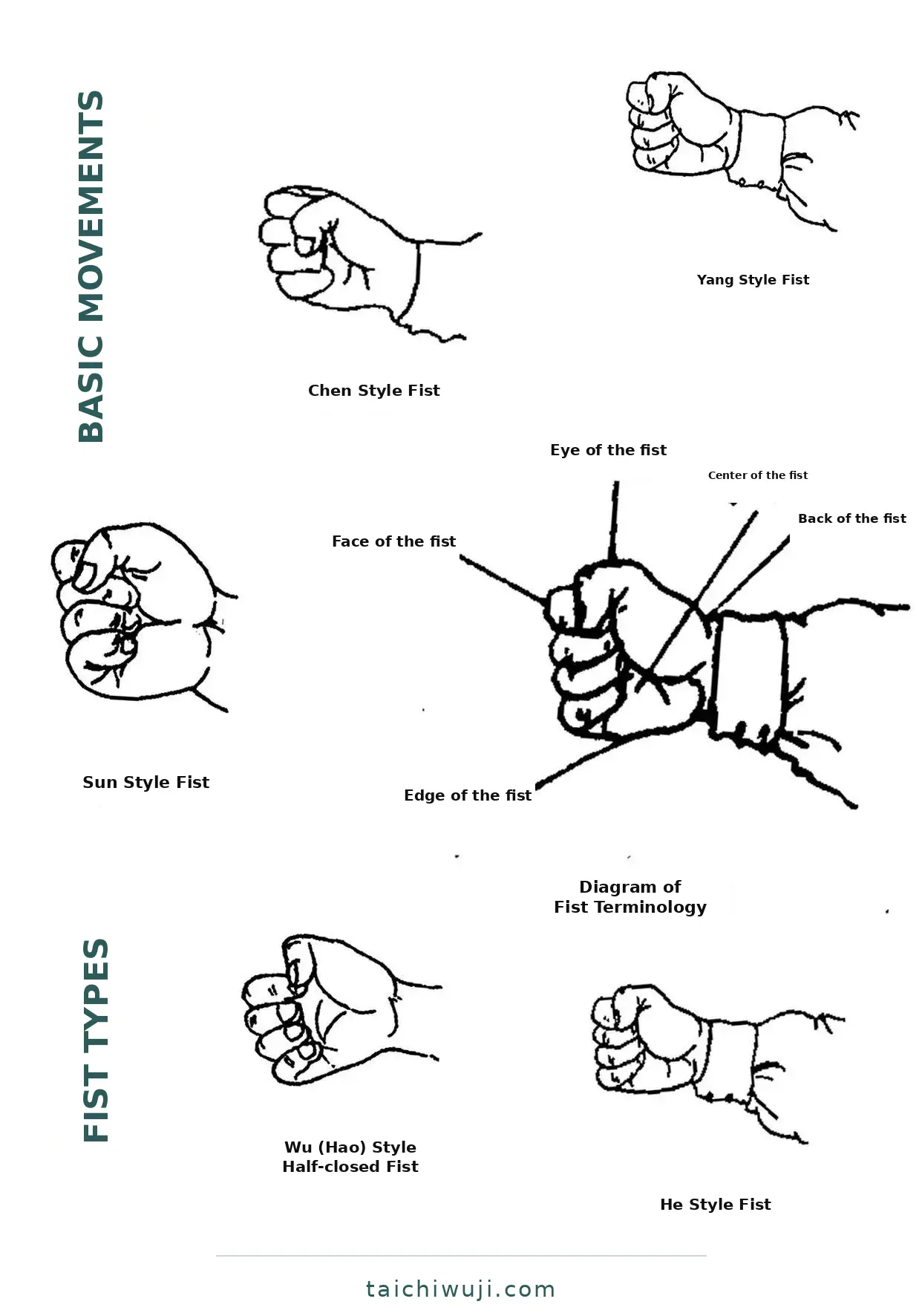
Figure 1. Fist (quán) forms across the major styles, after the commonly circulated chart. Two cautions discussed in the text: it omits Wu style and pairs He (Zhaobao) style with the four major styles without authoritative support — and line drawings cannot convey the real differences (thumb placement, hollow of the palm, tension).
They are selectively complete. The five major traditions are Chen, Yang, Wu, Wu (Hao) and Sun. Many charts drop Wu style and substitute He style, so the row reads as six peers when the six do not carry equal weight.
They cannot draw the differences that matter. The real variation lies in which joint the thumb presses, how much hollow the palm keeps, and how much tension is held — none of which survives a line drawing. Several fists that look identical on a chart are not a drawing error. They are close.
The palm is the accent you can hear across a room, the fist is the shared language every style speaks, and the hook is the dialect they are still arguing about.
Explore the Full Comparative Study
The member edition works through the primary material rather than the summaries: lineage teaching manuals, the classical texts, and the comparison tables most secondary sources are built from.
The member edition includes:
- All five traditions broken down hand form by hand form — which joint the thumb lands on, how much hollow the palm keeps, which fingers the Wu hook closes — with the competing descriptions of the Wu (Hao) fist and palm set side by side rather than reconciled.
- The names, sourced. Where the lotus-leaf palm came from and who standardised it, what Chen teaching material actually calls its own palm, and why “crane’s wing palm” has no source behind it.
- Six claims that circulate widely and do not hold, examined one at a time against the material they came from.
- The three competing descriptions of the tile palm, and what each implies about how the force is meant to travel.
- A practical section on what to feel for in each hand form, and what the shape is supposed to produce.
- A full Chinese–English terminology table covering hand forms, hand anatomy, palm names, lineage naming and related force concepts.
The central finding is narrower than the charts suggest: the fist is close to universal, the palm carries most of the style, and the hook is an open question. Knowing which is which is what separates a comparison from a list.
Continue reading — members only
The full study compares how Chén, Yáng, Wú, Wǔ/Hao and Sūn styles actually transfer weight and pivot, including where the sources disagree. Membership also unlocks every structured program and the members-only video library.
Unlock with membershipAlready a member?
Master Mingde Chen
12th generation Chen-style inheritor with decades of teaching experience.
View all articles →