What Zhan Zhuang Feels Like, Stage by Stage — and the Muscles Behind Each Sensation
On This Page
Loading...
Key Takeaways
- Zhan Zhuang belongs to isometric exercise — the same family as the wall sit and the plank: no joint movement, no impact, tension held.
- Weeks 1–2 feel hard because the work is in the wrong place. The load sits in the quadriceps and other surface muscles, and surface muscles fatigue fast.
- The long-term change is a handoff to deep stabilizers — the multifidus, the transversus abdominis, and the deep hip muscles. That handoff is what practitioners mean by “standing” instead of “holding on.”
- What research has actually measured: core muscle activation, heart-rate variability, brain activity, and blood pressure — the last of these as isometric exercise, the category zhan zhuang belongs to, not for zhan zhuang alone.
📥 Printable reference: Download the Zhan Zhuang Practice Guide (PDF) — a six-page A4 sheet with the six-point stance check, the stage-by-stage sensation table, the muscle reference, starting plans, and stop signals. It is a reference sheet, not a lesson; the stance itself needs to be felt.
Zhan Zhuang Is Isometric Exercise — You Just Never Called It That
Isometric exercise is the simplest idea in training: a muscle produces force without changing length. Push against a wall, hold a plank, sit against an invisible chair, and you are doing it. Nothing moves — but the muscle is working at close to full effort the entire time.
That puts it in a different family from running, cycling, and weightlifting, where muscles shorten and lengthen to move a joint. Zhan Zhuang, the standing post practice at the root of tai chi, sits squarely in the isometric family — see our zhan zhuang glossary entry for the traditional framing of the term.
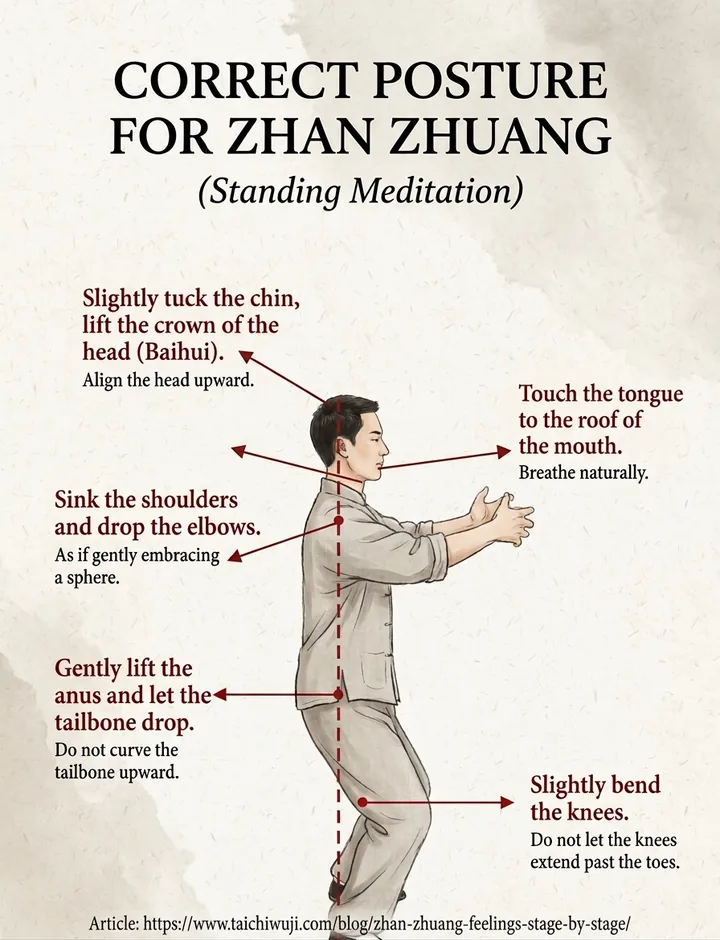
Two practical consequences follow from the mechanics:
- Almost no joint impact. The knee bends to a fixed angle and stays there, so there is no repeated loading of cartilage and no landing force. This is why physiotherapists prescribe isometric holds in early knee rehabilitation.
- The load is entirely up to you. You can sink deeper or stand higher, and the intensity changes instantly. There is no momentum to carry you and nothing to catch you.
The one number you should not misquote
In 2023, a network meta-analysis in the British Journal of Sports Medicine pooled 270 randomised controlled trials and 15,827 participants and ranked every major exercise mode by its effect on resting blood pressure. Isometric exercise finished first, with an average reduction of 8.24/4.00 mmHg — roughly double what aerobic training achieved in the same analysis (Edwards et al., 2023).
Read that carefully before you repeat it. The study measured isometric exercise as a category, and the trials inside it leaned heavily on wall sits and handgrip work. Zhan zhuang was not tested on its own. The honest sentence is “isometric exercise — the category zhan zhuang belongs to — lowered resting blood pressure in a large meta-analysis.” Writing “zhan zhuang lowers blood pressure by 8 mmHg” is a claim the data does not support, and a physiotherapy-literate reader will catch it.
Why the Feeling Changes: A Handoff From Surface Muscles to Deep Stabilizers
Start here: a sensation is not a mood. It is a report on muscle state. Soreness means metabolites have outrun clearance. Shaking means motor units are at their recruitment limit. Warmth means blood flow has opened up.
So when the feeling changes, something in the muscles has changed too. The working model is a handoff:
- At first, the load is carried by big surface muscles — the quadriceps, the calves, and anything else you already use for walking and climbing. They are built for power, not for holding, and they tire within minutes.
- As they fatigue, the body recruits deeper, smaller muscles that sit against the spine and around the hip. They are poor at producing force and excellent at sustaining it.
- Once those stabilizers are genuinely engaged, the surface can relax. The body feels supported from inside rather than braced from outside.
Traditional practice holds that this handoff is the entire point of the practice — that a practitioner deliberately “lets go” of the surface and hands the load inward. In Chinese this is described as changing the kind of force, 换劲. Two caveats belong in the same breath:
- No experiment has measured this switch inside a zhan zhuang hold. The model is consistent with what we know about motor-unit recruitment, but it has not been directly observed. Treat it as a working model.
- The hip muscle usually named here — the gluteus medius — has no zhan zhuang-specific EMG data. Rehabilitation literature is unanimous that it is a key hip stabilizer, and core-training studies measure it routinely, but nobody has measured it during a standing post. Say so.
The traditional vocabulary for the relaxed state that makes the handoff possible is rooting and yi, or intent — the deliberate attention that steers the work inward before the muscles can find it on their own.
From Week One to Year One: What You Will Feel, and What Is Working
The sequence below is the part almost nobody writes down. Sensation lists exist. Muscle lists exist — usually as a static inventory of “what zhan zhuang works.” What is missing is the pairing: this feeling, at this stage, because of these muscles.
If you are still learning the shape of the stance itself, start with Wuji Stance: How to Practice Standing Meditation Before Tai Chi and come back once the posture holds itself.
Week 1–2 — the burn starts in the thighs
Two or three minutes in, the front of your thighs begins to burn, and your calves feel heavy.
The muscle doing the work: the quadriceps group — the four muscles on the front of the thigh that straighten the knee. In a stance, they never fully straighten it. They hold it bent against gravity, contracting isometrically the whole time, and they are simply not built for that.
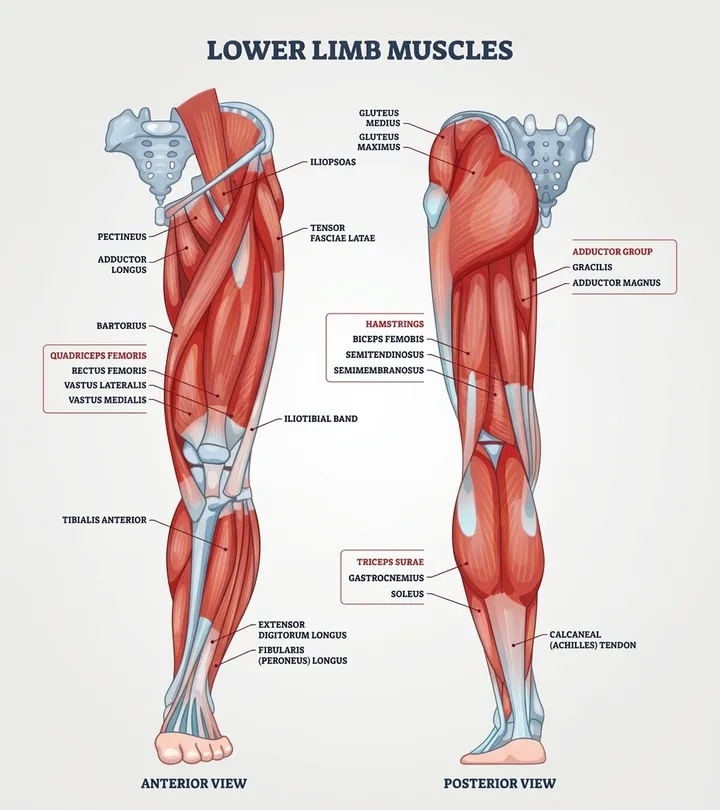
This is the least surprising finding in the whole field. A 2019 master’s study measured surface EMG in 21 healthy participants and found that core activation rose in a stance position — but the first muscles to complain, in every account of the practice, are always the quadriceps, because they carry the vertical load directly.
What to do: start at three minutes, not twenty. The first two weeks are about teaching the position, not proving endurance. If your knees ache rather than your thighs, the angle is too deep or the knees have travelled forward of the toes.
Weeks 2–3 — the shake
By the third or fifth minute, your legs begin to tremble. It is most obvious around the thighs and knees, and it can be oddly alarming the first time.
What is happening: motor units are being recruited at their ceiling. Shaking is not a warning sign and it is not “energy” — it is the normal signature of a muscle group operating at the edge of its capacity.
The muscle stealing your posture: the upper trapezius. This is the stage where almost everyone starts to cheat. Instead of letting the arms hang from the shoulders, you raise the shoulders to hold the arms up — and the trapezius, the large muscle running from the neck to the shoulder blades, takes a job it should never have accepted. The result is that your shoulders give out before your legs do.
What to do: sink the shoulders deliberately, keep the armpits open, and let the arms hold their shape without gripping. The stance should feel long, not tight.
Month 1 — heat
The burn recedes into the background, and the hands and feet warm up first, then the lower back and abdomen. Some people sweat lightly from the low back.
What is happening: blood flow and peripheral circulation are opening up. This stage is measurable rather than merely felt. In a controlled study at Beijing University of Chinese Medicine, students with elevated anxiety scores practised three-circle zhan zhuang for 10 weeks, at least five sessions a week. Compared with controls, their heart-rate variability shifted in a consistent direction: SDNN, RMSSD and pNN50 all rose, while normalised low-frequency power fell and normalised high-frequency power rose (Yan et al., 2019). Higher HF power is the standard marker of greater parasympathetic — “rest and digest” — activity.
What to do: keep the breathing natural. The dantian breathing practice is what most people add at this point, and the sensations you are now feeling are the same ones catalogued in How Qi Feels — that article sorts them by type; this one sorts them by time.
You may also notice something backward-looking here: the three signs most often quoted as “you’re doing it right” — breathing settling, hands and feet warming, a quiet sense of ease — are the subject of The 3 Golden Signs of Effective Tai Chi Stance. This article is not trying to replace that checklist. It is trying to tell you which of those signs arrives when.
Months 1–3 — numbness, tingling, and old injuries that wake up
The feet go numb or tingle, sometimes with a crawling sensation. Then the unpleasant part: the places that were already damaged start to hurt more, not less — an old lower back, an old knee, an old shoulder.
What is happening: these are the least mysterious sensations in the whole practice. Tingling is a circulation and nerve-signalling effect of prolonged stillness. The flare-ups come because a corrected posture redistributes load onto structures that had been compensating in silence for years. Something that was quietly overloaded gets to announce itself.
How to read it: the standard is simple.
- Continue if the reaction is wavelike — a few heavy days, then lighter — and your energy outside the practice is improving.
- Stop and reassess if it is locked to one spot and getting worse each session. That is not progress; that is a load problem or a posture problem.
If you have a diagnosed joint condition, the tai chi for arthritis research summary is the relevant reading before you push through anything.
Months 3–12 — the handoff
This is the stage the whole article has been building toward. The shoulders drop first. Then two things happen at once:
The hip takes over. The work shifts from the thigh to the deep muscles around the hip — the gluteus medius on the outer hip above all — which hold the pelvis level and stop the stance from collapsing inward.
The deep core takes over. The load moves to the transversus abdominis, the deepest abdominal layer, which wraps the waist like a corset and supports the lumbar spine, and to the multifidus, a chain of small muscles running segment by segment along the spine.
The core half of that transition is the part with hard data behind it. In the 2019 EMG study, holding a stance position significantly increased activation of the erector spinae, the multifidus, the left transversus abdominis and the right upper rectus abdominis compared with relaxed standing (Zhou, 2019). The study’s conclusion is exactly the claim of this section: the stance maintains spinal stability and trains the deep back and abdominal muscles.
This is the pivot from “braced” to “supported.” Our deep postural muscles article covers what these muscles can and cannot do for strength; the difference its numbers reveal is that a low stance pushes quadriceps activation only into the range of roughly a quarter of maximum voluntary contraction. Deep stabilizers are not about force. They are about endurance and alignment.
Year one and beyond — when it stops feeling like exercise
Breathing lengthens. The chest no longer feels tight. You may get drowsy mid-practice and finish clearer-headed than you started. Regular practitioners describe it less as training and more as maintenance.
What is happening: the changes at this timescale are slow and hard to detect from the inside. A one-year observation of zhan zhuang practice found no significant change in EEG measures at six months, but a measurable shift at one year, interpreted as a greater tendency toward brain-wave synchronisation (Yang et al., 1994). That single detail is worth more than any sensation, because it establishes the timescale: some of what this practice does takes a year to show up at all.
What Research Has Actually Measured in Zhan Zhuang
Splitting the evidence into what has been measured and what is traditional is the most useful thing a practitioner can do, and the fastest way to lose credibility is to blur the two.
Directly measured
| Finding | Study | Detail |
|---|---|---|
| A stance position raises core muscle activation | Zhou (2019), master’s thesis, 21 participants | Erector spinae, multifidus, left transversus abdominis and right upper rectus abdominis all significantly higher than in relaxed standing |
| 10 weeks of zhan zhuang shifts autonomic balance | Yan et al. (2019), Journal of Beijing University of Chinese Medicine | SDNN, RMSSD and pNN50 rose; low-frequency power fell and high-frequency power rose |
| Isometric exercise lowers resting blood pressure | Edwards et al. (2023), British Journal of Sports Medicine, 270 RCTs | −8.24/−4.00 mmHg; ranked first of all modes. Category-level, not zhan zhuang-specific |
| Four weeks of wall-sit training lowers blood pressure | O’Driscoll et al. (2023), Physiological Reports, 18 participants | Early systolic pressure −7.7 mmHg. The exercise is a wall sit, not a standing post |
| Long-term practice changes EEG | Yang et al. (1994) | No change at six months; a synchronisation tendency at one year |
Traditional, not yet measured
- The handoff itself — surface muscles yielding to deep stabilizers. Widely taught, never instrumented.
- The gluteus medius relay during a standing post. Established as a hip stabilizer in rehabilitation, unmeasured in this practice.
- The classical six-sensation sequence popularised by Yu Yong Nian in Dachengquan Zhan Zhuang and Seeking the Object: soreness, numbness, distension, warmth, tremor, ease. This is an excellent description of what practitioners report. It is not a study.
Presenting the first list and the second list in different type is not pedantry. It is the difference between a site a physiotherapist will cite and one they will dismiss.
For Desk Workers and the Recovering Body: Where to Start
Two audiences get more from zhan zhuang than anyone else, for opposite reasons. Desk workers have normal muscles in a badly managed posture. People in rehabilitation have a limited tissue budget and need a load they can control precisely.
If you sit for a living
Sitting all day is not undone by a workout. Prolonged uninterrupted sitting carries metabolic and cardiovascular risk that persists even in people who exercise regularly, and the posture itself shortens the hip flexors, rounds the shoulders and lets the deep core go dormant.
The rule that matters is frequent interruption, not longer sessions. Standing up for three minutes every hour beats twenty minutes in the evening.
| Week | Duration | Frequency | Focus |
|---|---|---|---|
| 1 | 3–5 min | Morning and evening | Standing correctly, not standing long |
| 2 | 5–8 min | Twice daily | Check for raised shoulders and knees past the toes |
| 3 | 10 min | Once or twice daily | Add a 3-minute stand every sitting hour |
| 4 | 15 min | Once daily | Walk for five minutes afterwards before sitting down |
- Keep the daily total between 10 and 30 minutes. More is not better here.
- Do not sit down immediately after a session. Walk first.
- If weight loss is part of your goal, Tai Chi for Weight Loss covers the metabolic side of the practice; the zhan zhuang weight-loss article covers what standing specifically does and does not contribute.
If you are recovering from an injury
Recovery plans cannot be generic. They depend on which tissue is involved and what it is currently cleared to tolerate. These are starting points, not prescriptions — clear them with your clinician or physiotherapist before you follow them.
- Knee surgery or knee injury. Begin with a wall-supported hold: back against the wall, knee bent to roughly 45°, held for 30 seconds, building toward five minutes. The wall takes part of the load. The knee must not travel past the toes. Isometric holds at this angle are a standard early-stage rehabilitation tool for the quadriceps.
- Lower back problems. Use a wall-supported static stand with five points of contact — back of the head, upper back, buttocks, calves and heels. Five minutes is plenty at first. When in doubt, stand higher, never lower, and keep the tailbone gently tucked rather than letting the lower back arch.
- Older adults and anyone with balance or blood-pressure instability. Keep one hand on a chair back. Do not stand with the eyes closed. Avoid heel raises entirely. Do not practise within 30 minutes of a meal.
When to Stop
Fatigue is the point of the practice. These are not fatigue:
- Sharp or pinpoint joint pain, or pain in one leg only.
- Chest tightness, palpitations, dizziness or faintness.
- Pain that worsens as you stand rather than plateauing.
- A session that ends in exhaustion rather than ease.
Do not begin a zhan zhuang practice on your own if you have a meniscus tear, a ruptured cruciate ligament, a patellar dislocation, an acutely inflamed and swollen joint, severe osteoporosis, uncontrolled severe hypertension, significant cardiac or cerebrovascular disease, or severe vertigo. If a surgeon has told you not to bear weight statically yet, that instruction stands. Zhan zhuang supports rehabilitation; it does not replace treatment.
Frequently Asked Questions
What does zhan zhuang feel like?
Most practitioners meet the sensations in a loose order: the thighs burn in the first minutes, the legs may tremble around minute three to five, the hands and feet warm after a few weeks, numbness or tingling can come and go, and the standing eventually feels quiet and supported rather than braced. This article maps each stage to the muscles producing it. The sequence is a description of common reports, not a timetable everyone must follow.
Is zhan zhuang an isometric exercise?
Yes. Isometric exercise means a muscle produces force without changing length, and zhan zhuang holds a fixed posture under tension — the same family as the wall sit and the plank. There is no joint movement and no impact. That is why physiotherapists use isometric holds in early knee rehabilitation, and why the intensity can be adjusted instantly by standing higher or lower.
Why do my legs shake during zhan zhuang?
Trembling is the normal signature of motor units working near their recruitment ceiling, not a sign of “energy” released and not an injury signal in itself. The shoulders are a common weak point: many beginners raise them to hold the arms up, and the upper trapezius gives out before the legs do. Sink the shoulders and keep the armpits open. Sharp or one-sided joint pain is different — that is a reason to stop and reassess.
Does zhan zhuang lower blood pressure?
Be careful with this one. A 2023 network meta-analysis found that isometric exercise as a category lowered resting blood pressure by an average of 8.24/4.00 mmHg, but the trials were mostly wall sits and handgrip work — zhan zhuang was not tested on its own. The defensible statement is that isometric exercise, the category zhan zhuang belongs to, reduced blood pressure in that analysis. Writing “zhan zhuang lowers blood pressure by 8 mmHg” overstates the evidence.
How long before zhan zhuang starts to feel easier?
The first two weeks are about learning the position, usually starting at three to five minutes rather than twenty. The tremor and burn are early-stage experiences; warmth and a sense of being supported from inside typically arrive later, as the work shifts from surface muscles to deep stabilizers. One small study found no measurable EEG change at six months but a shift at one year — a reminder that some effects of a slow practice take a long time to appear. Individual timing varies, and progress is not a straight line.
Your Next Step
Stand for three minutes, today, before you decide whether any of this is true. Watch where the burn lands, notice whether your shoulders have crept up, and stop while it still feels manageable.
Then come back in a week and read the months-3-to-12 section again. You will recognise more of it than you expect.
References
Edwards, J. J., Deenmamode, A. H. P., Griffiths, M., Arnold, O., Cooper, N. J., Wiles, J. D., & O’Driscoll, J. M. (2023). Exercise training and resting blood pressure: A large-scale pairwise and network meta-analysis of randomised controlled trials. British Journal of Sports Medicine, 57(20), 1317–1326. https://doi.org/10.1136/bjsports-2022-106503
Edwards, J. J., Wiles, J., & O’Driscoll, J. (2022). Mechanisms for blood pressure reduction following isometric exercise training: A systematic review and meta-analysis. Journal of Hypertension, 40(11), 2299–2306. https://doi.org/10.1097/HJH.0000000000003261
O’Driscoll, J. M., Edwards, J. J., Wiles, J. D., et al. (2023). The effect of isometric exercise training on arterial stiffness: A randomized crossover controlled study. Physiological Reports, 11(9). https://pmc.ncbi.nlm.nih.gov/articles/PMC10199235/
Yan, J., Zhai, X., Wei, Z., Zhang, J., & Wei, Y. (2019). [Analysis of heart-rate-variability effects induced by three-circle zhan zhuang intervention in anxious college students]. Journal of Beijing University of Chinese Medicine, 555–559. https://d.wanfangdata.com.cn/periodical/bjzyydxxb201907006
Yang, S. H., Yang, Q. F., & Shi, J. M. (1994). [Observation of electroencephalogram spectrum changes over one year of Qigong training]. https://pubmed.ncbi.nlm.nih.gov/7703628
Zhou, X. (2019). Study on surface EMG changes of back and abdominal core muscles in healthy people under health-preserving taiji zhan zhuang [Master’s thesis, Liaoning University of Traditional Chinese Medicine]. https://d.wanfangdata.com.cn/thesis/D02172733
Yu, Y. N. Dachengquan zhan zhuang and seeking the object [traditional practice text; sensation sequence referenced above]
Related Terms
Explore Full MapMaster Mingde Chen
12th generation Chen-style inheritor with decades of teaching experience.
View all articles →