Why it is not just the standing form, sitting down
Dr. Wang did not simply cut the legs off a Yang-style form. He applied for research funding and tested it.
Two grants:
| Funder | Grant number |
|---|---|
| Paralyzed Veterans of America (PVA) | PVA Education Foundation Grant # 592 |
| National Institute on Disability and Rehabilitation Research (NIDRR) | NIDRR Grant Number H133E080003 |
The money paid for lab work. Wheelchair users practised the set with biomechanical sensors attached, while the team measured heart rate, muscle activation, upper-limb joint loading and psychological stress markers.
The results were published in 2015 in the Journal of Physical Education, Recreation & Dance: Wang, Y. T., Chang, L.-S., Chen, S., Zhong, Y., Yang, Y., Li, Z., & Madison, T. (2015). Wheelchair Tai Chi as a Therapeutic Exercise for Individuals with Spinal Cord Injury. JOPERD, 86(5), 27–37. DOI: 10.1080/07303084.2015.1022673
A full run-through takes 8 to 10 minutes. The paper reports gains in cardiorespiratory endurance, shoulder and upper-joint range of motion, plus improvements in the anxiety and depression scores common among people with spinal cord injury. Those sit alongside the broader benefits documented for standing practice, though the measurements here were taken seated and on this group.
The article also sets out eight principles for practising it — relaxation, head position, chest and back placement, shoulders and elbows, waist, distinguishing empty from full, coordination of upper and lower, and breath — with each of the ten forms broken down and illustrated. The first of those, Song, is the one most often mistranslated as plain relaxation; seated practice makes the difference easier to feel, because there is no stance to hide behind.
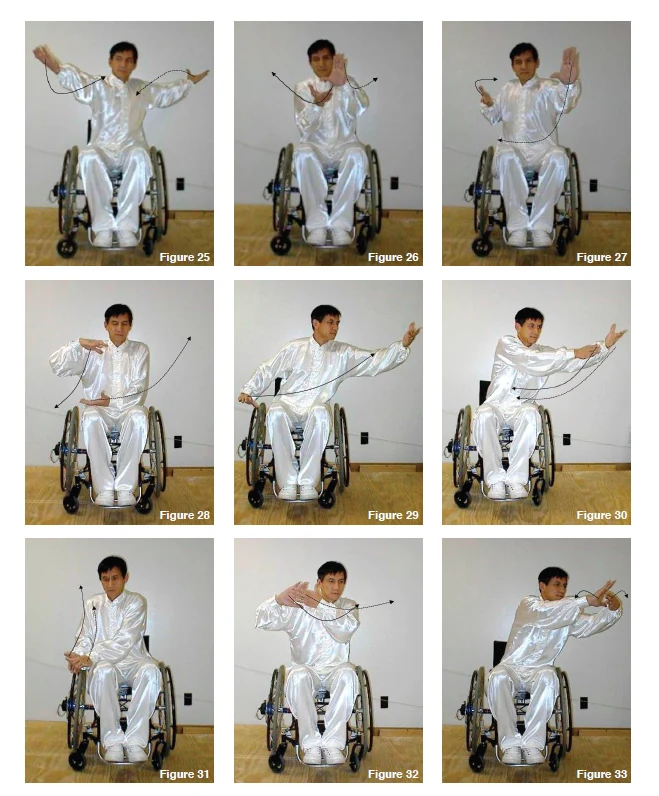
The ten forms
Taken from the published sequence. The repeated Single Whip is not a typo — the original repeats it in the second section.
| # | English | Chinese |
|---|---|---|
| 1 | Commencing Form | 起势 |
| 2 | Part the Wild Horse's Mane | 野马分鬃 |
| 3 | Single Whip | 单鞭 |
| 4 | Wave Hands Like Clouds | 云手 |
| 5 | Single Whip | 单鞭 |
| 6 | Whirl Arms on Both Sides | 左右穿梭 |
| 7 | Grasp the Bird's Tail – Left Side | 左揽雀尾 |
| 8 | Grasp the Bird's Tail – Right Side | 右揽雀尾 |
| 9 | Cross Hands | 十字手 |
| 10 | Closing Form | 收势 |
Six of the ten keep their classical names — Commencing, Wild Horse's Mane, Single Whip, Cloud Hands, Grasp the Bird's Tail and Closing. If you already know the standing versions, the forms guide maps the full standing sequences these come from.
Who this is for
WTC10 was built and measured on people with spinal cord injury, but the movement problem it solves is broader than that diagnosis. If you cannot stand for the length of a practice, the question is the same.
- If the barrier is joint pain rather than balance — Tai Chi for arthritis covers what the research supports for standing and seated practice both.
- If you are seated because of back problems, the back pain guide sets out which movements help and which to leave out.
- If balance is the concern and standing is still possible, Tai Chi for balance is the standing counterpart to this set.
- If you are starting later in life with no prior practice, starting over 50 assumes no mobility you do not have.
For the public health case behind seated and adapted practice, the CDC's position on arthritis and fall prevention is worth reading before you decide this is only for people in wheelchairs.
Watch the form
Taught by Dr. Wang himself, ten forms in order, seated throughout.
If the player does not load, the video is at youtube.com/watch?v=bJHyFrDmXgU.
Get the paper
Form table and full paper
researchgate.net — Wheelchair Tai Chi 10 Forms
ResearchGate requires a free account to download.
The paper directly
doi.org/10.1080/07303084.2015.1022673