Tai Chi Glossary > Liu Zi Jue (六字诀)
Liu Zi Jue (六字诀)
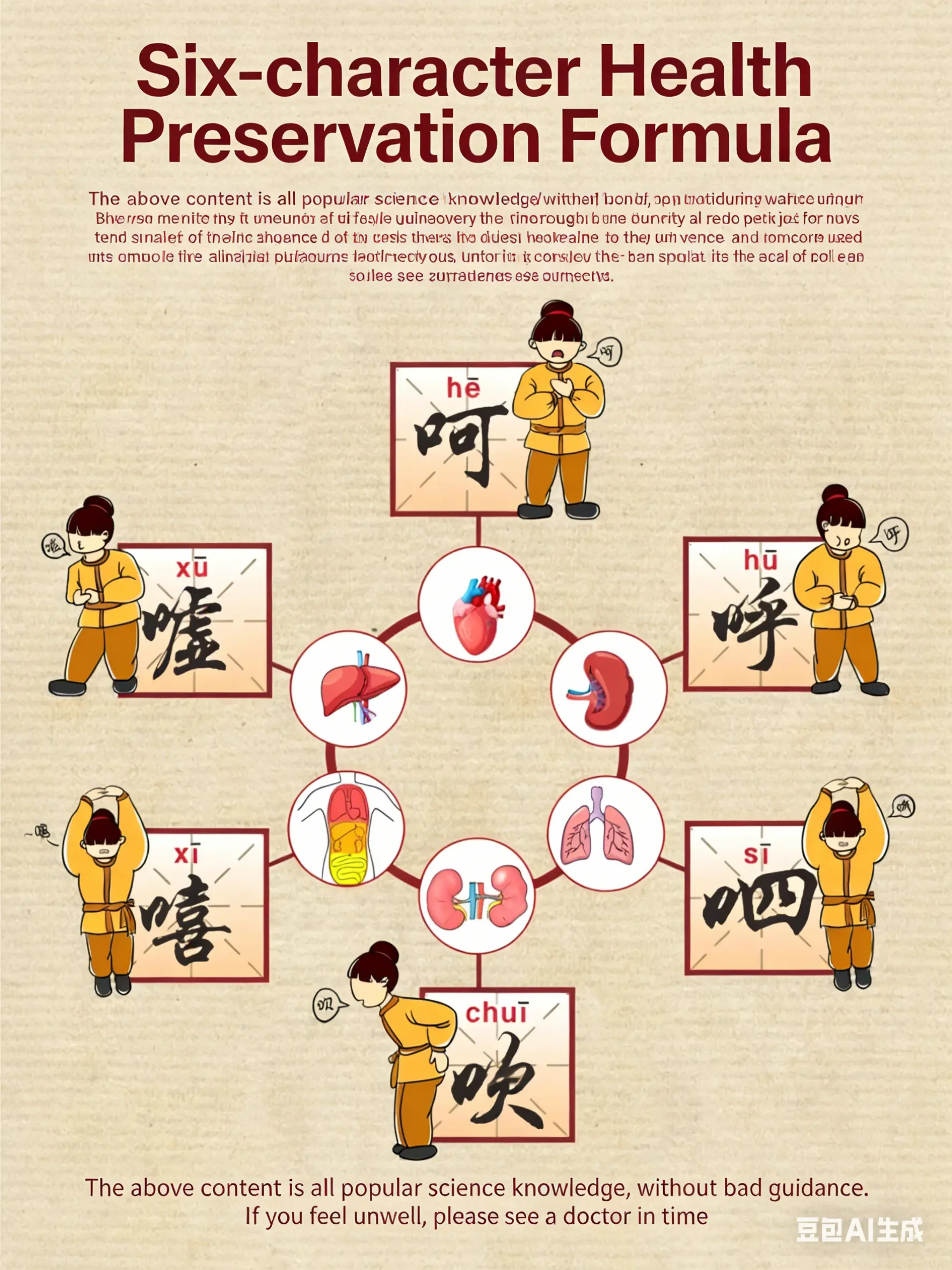
Definition: Liu Zi Jue (六字诀) is a classical Chinese qigong practice using six specific sounds—Xu, He, Hu, Si, Chui, Xi—each coordinated with breath, a mouth shape, a small movement and often self-massage. In traditional Chinese medicine each sound carries an organ association; that mapping is a historical framework, not a medical claim.
Among the oldest and most systematically documented qigong practices in the Chinese tradition, Liu Zi Jue has been refined over fifteen centuries and is one of the four official health qigong forms promoted by the Chinese national health qigong centre. Its premise is simple: every sound has its own mouth shape and resonance, and it is practised with a matching movement and a long, relaxed exhalation. How that is understood—the idea that a sound resonates in a particular region and works along a meridian pathway—belongs to classical theory. It is a framework for describing and remembering the practice, not a clinical mechanism.
In Brief:
- 六字诀 (liù zì jué): “six-character formula”—六 is six, 字 is character/sound, 诀 is formula or secret method
- Each of the six sounds carries a traditional association with one organ system and one Five Elements phase
- Coordinated with gentle movement, breath and yi (intention); in classical theory this directs qi along the corresponding jingluo meridian pathways
- Historically attributed to Tao Hongjing (456–536 CE) of the Southern Qi dynasty, with further development by Sun Simiao (581–682 CE)
- Distinguished from other qigong by its use of sound: the voice itself is the working element
The Six Sounds and Their Correspondences
Each sound carries traditional associations with an organ-meridian system, an emotional theme and a season. The table below summarizes the classical correspondences:
| Sound | Pinyin | Organ | Element | Season | Emotion Addressed |
|---|---|---|---|---|---|
| 嘘 | Xū | Liver / Gallbladder | Wood | Spring | Anger, frustration |
| 呵 | Hē | Heart / Small Intestine | Fire | Summer | Anxiety, agitation |
| 呼 | Hū | Spleen / Stomach | Earth | Late Summer | Worry, overthinking |
| 呬 | Sī | Lung / Large Intestine | Metal | Autumn | Grief, sadness |
| 吹 | Chuī | Kidney / Bladder | Water | Winter | Fear, insecurity |
| 嘻 | Xī | San Jiao (Triple Burner) | — | — | General stagnation |
The San Jiao (三焦) is a TCM concept without a direct anatomical equivalent in Western medicine—it refers to three functional regions of the torso (upper, middle, lower) that govern the overall distribution and transformation of qi and fluids throughout the body. The Xi sound addresses the San Jiao as a regulatory system, and classical texts treat it as a general closing sound for the whole set.
How the Sounds Work
Classical theory describes how the sounds work through several channels at once.
Vibrational resonance is the most distinctively Chinese element. Each sound, when produced correctly, creates a specific pattern of resonance in the thoracic and abdominal cavities. Classical theory holds that this resonance acts on the organ and its meridian pathway. That is a statement about traditional understanding, not a measured physiological effect. The sound of Xu, for example, is said to resonate in the region of the liver and gallbladder; Chui in the kidney region of the lower back.
Voice and breath physiology are studied in their own right. What is not established is any link between a particular sound and a particular organ: the organ correspondences are part of the classical framework rather than a finding of modern research. See clinical evidence for how this site separates the two.
Breath regulation is equally important. Each sound requires a specific breath pattern: a controlled, extended exhalation. The long exhale is the part most likely to be of general benefit, because slow breathing with a longer out-breath is the technique most consistently associated with a calmer state. The traditional claim that this breath also massages the internal organs through diaphragmatic movement belongs to the same framework.
Yi and meridian direction completes the triad. The practitioner’s yi (intention) is directed to the relevant organ and meridian pathway during each sound. The classical principle yi dao qi dao (意到气到)—where intention goes, qi follows—means that focused attention during a sound is used in practice to keep the movement and the breath coordinated.
The Movements
Unlike purely meditative qigong, Liu Zi Jue in its standard modern form coordinates each sound with specific gentle movements. These movements serve multiple purposes: they open the body structure to allow qi circulation, they reinforce the directional intention of each sound, and they prevent the practice from becoming purely static.
The Xu movement typically involves gentle eye opening and arm extension to the sides—the liver opens through the eyes in classical theory, and extending the arms opens the Liver meridian pathways along the inner arms. The Chui movement often involves a slight forward curve and arm wrapping, protecting and warming the kidney region of the lower back. Each movement follows this organ-specific logic rather than being assigned arbitrarily.
In the standardized Health Qigong version the sequence runs in a fixed order that follows the Five Elements generating cycle: Xu (Wood) → He (Fire) → Hu (Earth) → Si (Metal) → Chui (Water) → Xi (San Jiao). This order is not cosmetically Chinese—it follows the Five Elements sequence of Wood feeding Fire, Fire producing Earth (ash), Earth yielding Metal, Metal holding Water. Each organ system nourishes the next in the cycle.
Historical Development
The earliest systematic description of healing sound practice appears in Yangxing Yanming Lu (养性延命录, Records for Nourishing Life and Extending Destiny) by Tao Hongjing (456–536 CE), who documented six healing sounds as part of a broader longevity practice system. Sun Simiao (581–682 CE), the great Tang dynasty physician, further developed and systematized the practice in his Beiji Qianjin Yaofang (备急千金要方, Essential Formulas for Emergencies Worth a Thousand Gold Pieces)—one of the foundational texts of Chinese medicine.
Over subsequent centuries, Liu Zi Jue was refined through Daoist, Buddhist, and medical lineages, each contributing modifications to the movements and theoretical framework. The modern standardized form was organized by the national health qigong centre, drawing on historical sources to create a teachable set for contemporary practitioners while keeping the classical sound-to-organ framework intact.
Liu Zi Jue in Practice
Liu Zi Jue is used in a way that distinguishes it from more general qigong forms like Baduanjin. Ba Duan Jin is built around standing patterns and structural strength; Liu Zi Jue is built around the voice, so a practitioner often works with a single sound for a while rather than running the whole sequence. In the classical framework each sound is matched to an organ, an emotion and a Five Elements phase—chronic anxiety is paired with Hē (Heart/Fire), persistent grief with Sī (Lung/Metal), ongoing fear with Chuī (Kidney/Water). Choosing a sound this way is a traditional way of working, not a diagnosis. The written version lives in the beginner guide, and the full practice is taught form by form in the Liu Zi Jue course.
Classical practitioners developed sensitivity to these relationships over years of study. A modern approach is simpler: if one sound feels harder to produce than the others, or easier to hold, that is useful information about your own attention and breath, and nothing more.
The practice is gentle enough for all ages and fitness levels, requires no equipment, and can be practiced in a very small space. These characteristics make it particularly valuable for practitioners with health limitations that prevent more physically demanding qigong or tai chi practice.
- Qigong — the broader practice tradition within which Liu Zi Jue is one of the best documented forms
- Five Elements — the phase framework governing the organ correspondences of each sound
- Jingluo — the meridian network that classical theory uses to describe the pathways each sound works along
- Qi — the vital energy that traditional theory says the sounds and movements circulate
- Yi — intention directed to specific organs during each sound
- Baduanjin — the complementary health qigong form, built around standing patterns and structural strength
- Dan Tian — the energy center whose activation supports all Liu Zi Jue practice
- Dantian Breathing — the structured breathing many practitioners pair with the sounds
- Energy Flow — the qi circulation that the sounds and movements are built around
- Hard Qigong — the contrasting qigong tradition that develops physical resilience rather than organ regulation
Have questions about Liu Zi Jue practice or the Six Healing Sounds? Our forum thread — Qigong FAQ: Everything Beginners Ask — Answered by Senior Practitioners — covers this and many more topics answered by experienced practitioners.
Related Glossary Terms
Explore connected concepts in the Tai Chi knowledge graph.
Community & Questions
Discussions from practitioners about liu-zi-jue.
Further Reading & Practical Guides
In-depth articles featuring liu-zi-jue.
Not All Qi Is the Same: The 5 Types of Qi in Qigong and Chinese Medicine
Discover the five types of Qi — Yuan, Gu, Zong, Ying, and Wei — and how they function in your body. Learn which Qi type you need to cultivate, with simple practices and scientific parallels.
Qigong for Beginners: What to Practice First and What to Ignore
Qigong is one of the simplest ways to begin internal practice. This guide explains what Qigong is, how it differs from Tai Chi, what beginners should practice first, and how to build a short routine for breathing, posture, and calm.
Liu Zi Jue (Six Healing Sounds): What It Is, How to Practise the Six Sounds, and What the Evidence Does and Does Not Say
A practical, evidence-aware guide to Liu Zi Jue (六字诀), the six-sound health qigong practice: what each sound is for, how to shape the mouth, how the breath works, and an honest account of what research does and does not show.
Practice music for the standard routines
Each routine has a short recording that runs about 6 to 8 minutes, which is the right length for a daily session, and a full-length recording for learning the sequence through.
- Ba Duan Jin6:1418 full · members
- Liu Zi Jue6:2418 full · members
- Wu Qin Xi6:2118 full · members
- Shi Er Duan Jin7:2418 full · members
- Da Wu7:3018 full · members
- Tai Ji Yang Sheng Zhang7:4018 full · members
- Dao Yin Yang Sheng Gong7:2318 full · members
- Yi Jin Jing6:2018 full · members
- Ma Wang Dui Dao Yin Shu7:29 - 7:3018 full · members