Try this now: Stand naturally, arms at your sides. Feel the “tiger’s mouth” between your thumb and index finger—is it collapsed and flat? Notice your palms—are they tense or truly relaxed? Check your shoulders—are they creeping up toward your ears after hours at a screen?
If you answered yes, you’re not alone. 99% of Taijiquan practitioners unknowingly carry this flaw from day one, because they’ve skipped the most fundamental preparation of all: the Wuji Hand.
Without it, your forms remain stiff, your internal energy (qi) cannot flow freely, and the martial essence of Tai Chi feels out of reach.
This guide will help you reclaim this “pre-kung fu” key, transforming it into your secret source of balance, power, and fluid grace.
What is the Wuji Hand? (It’s Not Just “Relaxed Hands”)
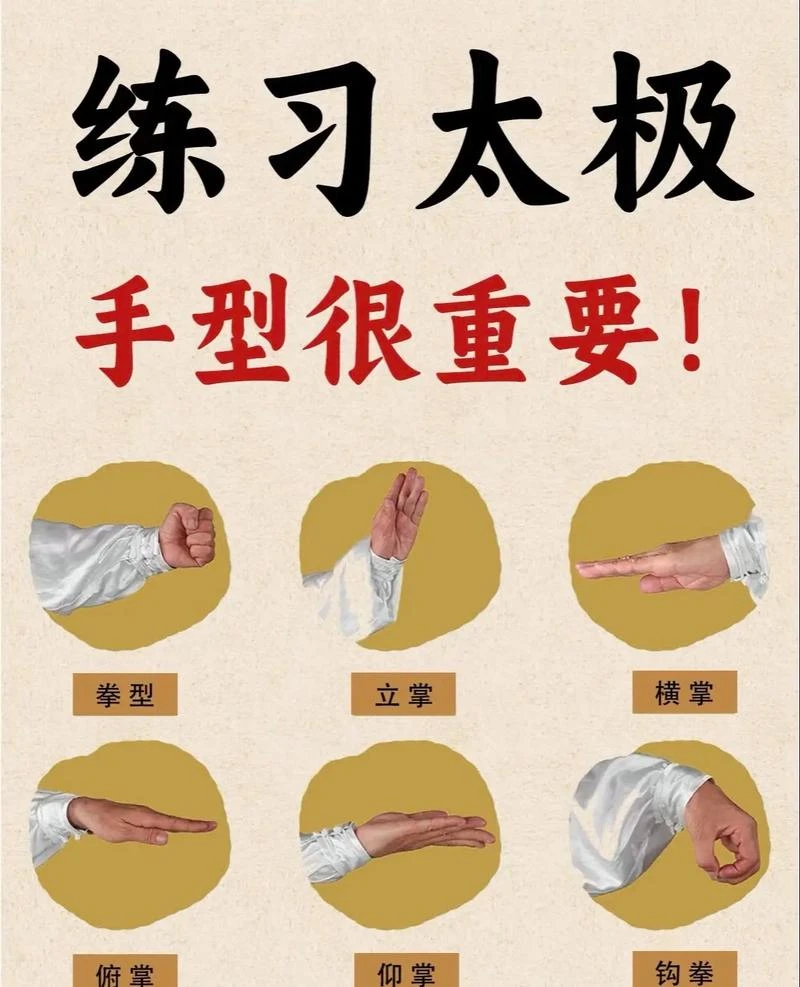
The Wuji Hand is far more than “letting your hands hang.” In Daoist philosophy, it represents the state of “Wuji”—the primordial, undifferentiated emptiness before the polarity of Yin and Yang (“Taiji”) emerges. It is not an action you perform, but a natural state you return to.
Across styles, it’s known by different names: “Hunyuan Hand” (Chen Style), “Drooping Hand” (Yang Style), or “Chaotic Hand” in classical texts.
Yet its principles are universal. Visually, it is characterized by:
- A rounded, open tiger’s mouth (as if holding a small egg).
- A hollow, relaxed center (Laogong point) in the palm.
- Fingers gently curved inward, not stiff nor completely straight.
- A “seated” wrist, with a slight, natural flexion.
Common Errors vs. Correct Form: A collapsed tiger’s mouth blocks energy pathways; stiff fingers create local tension. The correct structure facilitates optimal circulation.
A Modern Anatomical View: This alignment is biomechanically intelligent. The “seated wrist” properly positions the ulna and radius bones for efficient force transmission. The “empty palm” stretches the palmar fascia, enhancing blood flow and nerve conduction—particularly along the Heart and Pericardium meridians from Traditional Chinese Medicine.
This isn’t mystical; it’s functional design that counteracts the rounded shoulders and impingements common in modern life.
Why Has This Foundation Been Forgotten?
Two main reasons:
- The Modern Body: “Tech neck” (forward head posture) and rounded shoulders from prolonged sitting and phone use make true shoulder relaxation and scapular setting physically difficult.
- Rushed Learning: Many classes jump directly into the “Commencement” form, omitting this silent, foundational prelude. Yet, as Zhang Sanfeng emphasized in the Taijiquan Classic, the essence is in one word: “Song” (松) — to loosen, to relax. Ultimate relaxation is the gateway to Wuji.
The 5 Hidden Functions of Wuji Hand (And How to Feel Them)
These are not theories but tangible experiences:
The Instant Reset
It neutralizes all unnecessary muscular tension, creating a “zero point” for movement.
Partner Drill: Have a friend apply light pressure to your forearm while you maintain Wuji Hand. Instantly relax your shoulder, elbow, and wrist. Feel their force “dissipate into emptiness”—a direct taste of Tai Chi’s neutralizing power.
Architect of the Sinking Chain
It establishes the critical connection: shoulder blades sink → elbows drop → wrists seat. This chain directs your body weight downward, creating rooted power and turning your arms into resilient, spring-like extensions.
Meridian Activator
From a TCM perspective, it naturally opens the Hand-Shaoyin (Heart) and Hand-Jueyin (Pericardium) channels. A common result? Noticeably warmer palms after just a few minutes of proper practice.
The Blueprint for Peng (Ward-Off)
The rounded, supported structure of Wuji Hand is the exact template for the first fundamental energy, Peng, in movements like “Lan Que Wei” (Grasp Sparrow’s Tail). Your first defensive move thus originates from a state of natural fullness, not forced effort.
Pathway to “Cold Jin”
When Wuji Hand becomes instinctive, the internal energy (jin) condenses.
A Practitioner’s Account: “After mastering Wuji Hand, my push-hands partner described contact with my arm as ‘touching an iron bar wrapped in soft cotton—followed by a sudden, penetrating coolness.’” This “cold jin” is a sign of highly focused, non-dispersive internal force.
Your 30-Day Wuji Hand Training Plan
Transform understanding into habit with this progressive plan. Safety First: Initial shoulder soreness is normal as muscles release, but sharp joint pain means stop. Limit early sessions to 10-15 minutes.
| Week | Focus | Daily Practice (10-15 mins) | Key Tip |
|---|---|---|---|
| 1 | Static Form | Stand in Wuji posture. Focus only on perfecting the hand shape. Breathe naturally. | Use a mirror. The tiger’s mouth should be round without clenching. |
| 2 | Dynamic Integration | Walk slowly, maintaining Wuji Hand awareness. Integrate into daily moments (e.g., waiting in line). | Let it become a subconscious habit of “how your arms rest.” |
| 3 | Application in Contact | In push-hands practice, use Wuji Hand to receive and neutralize light pressure. Focus on “returning to Wuji” between exchanges. | Think of Wuji Hand as your “home base” to recharge during transitions. |
| 4 | Embed in Your Form | Begin and end every form sequence with conscious Wuji Hand. Let it inform the quality of every transition. | View pauses not as stops, but as active “charging moments” in this state. |
By the end of one month, your Taijiquan will feel more grounded, connected, and effortlessly fluid.
Conclusion: Your Key Awaits
Zhang Sanfeng’s wisdom holds true: the pinnacle of “Song” (looseness) is Wuji. By mastering the Wuji Hand, you don’t just correct a posture—you unlock the door to authentic, internal Taijiquan.
Ready to Visualize? Watch our short video breakdowns highlighting each of the 5 functions on our social media. Join the Challenge! Share your progress using #MyWujiHandJourney for a chance to get personalized feedback from our coaches.
Wuji Hand – FAQ
What exactly is Wuji Hand in simple terms?
Wuji Hand is the natural, relaxed, and structurally aligned way your hands should hang before you even begin any Tai Chi movement. It's the "zero point" or "home base" posture that establishes correct energy flow and connection from fingers to the core.
How is Wuji Hand different from just relaxing my hands?
Relaxation is passive; Wuji Hand is active alignment. It requires specific, subtle actions: rounding the tiger's mouth, hollowing the palm (Laogong point), and "seating" the wrist. This creates a template for all subsequent Taijiquan techniques.
Can learning Wuji Hand really improve my Tai Chi quickly?
Yes, dramatically. By mastering Wuji Hand first, you correct the root cause of stiffness and disconnected movement. Practitioners often report feeling more rooted, fluid, and internally connected within weeks, as all techniques now stem from a correct foundation.
I have wrist/shoulder pain. Can Wuji Hand help?
Correct Wuji Hand practice promotes healthy joint alignment and releases chronic tension in the shoulders and arms. However, start gently. If you have existing injury, consult a coach to adapt the posture. The focus is on releasing, not forcing.
Do I need to practice Wuji Hand standing still, or can I use it while moving?
Start static (in Wuji stance) to build awareness. Then, integrate it into walking and daily activities. Ultimately, the goal is to make it your default state, so you can "return to Wuji" in the gaps between every Tai Chi movement.