Have you ever watched a seasoned Tai Chi practitioner move with such effortless grace and profound calm that it seems they exist in a different flow of time? The secret to achieving this state lies not in complex, hidden techniques, but in mastering a set of core internal principles.
For practitioners at Tai Chi Wuji, the journey beyond mere movement is guided by what we call the “Five Essential Principles” (五字诀): Tranquil Mind (静心), Light Agility (轻灵), Slow Practice (慢练), Precision Alignment (切合), and Perseverance (恒心).
These principles are the bridge between performing a sequence of postures and truly embodying Tai Chi.
They transform your practice from an external exercise into an internal art of mind-body integration, energy cultivation, and philosophical living.
This comprehensive guide will deconstruct each principle, offering you concrete, step-by-step methods to integrate them into your daily practice and unlock the deeper dimensions of Tai Chi.
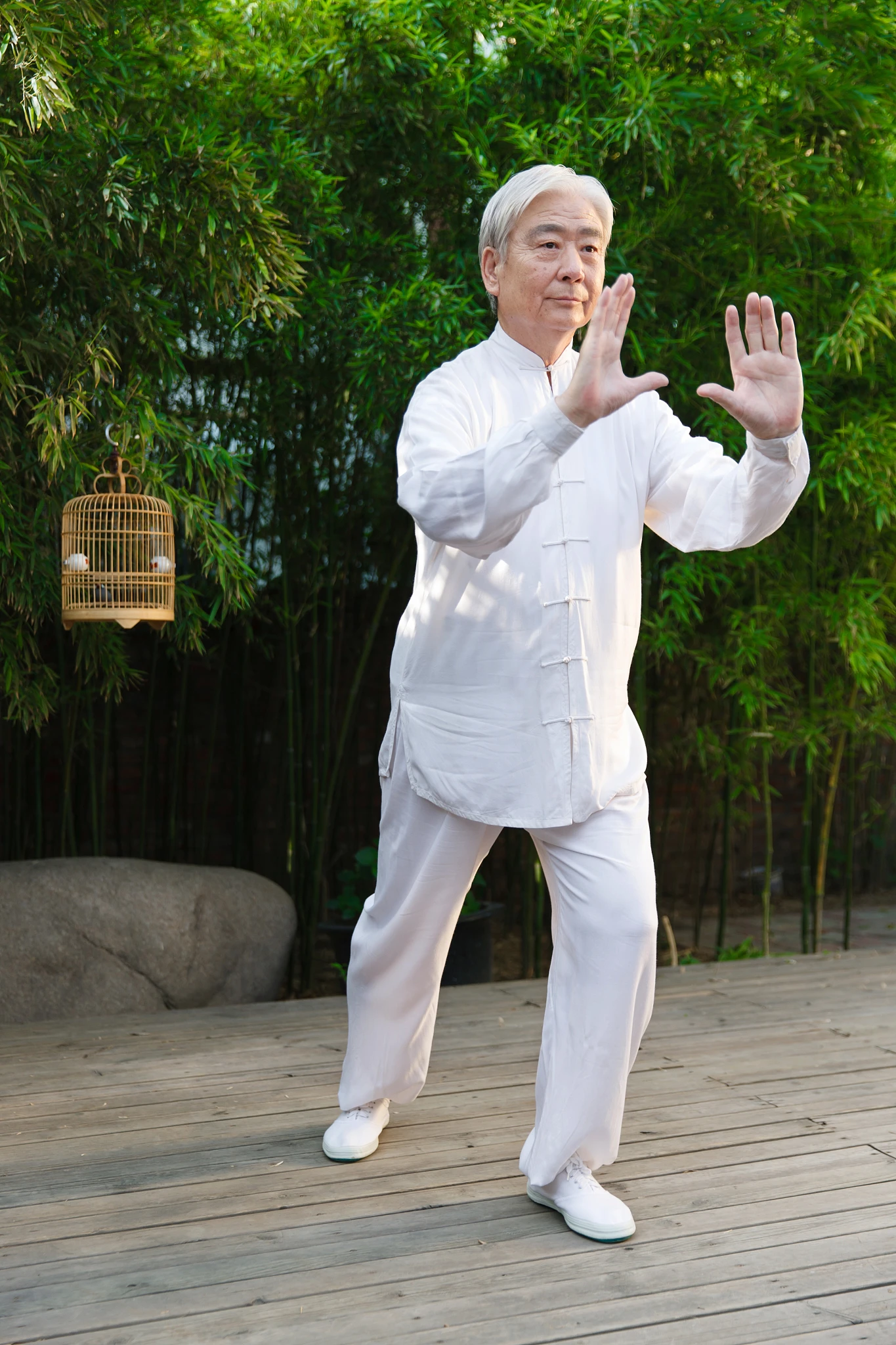
1. Tranquil Mind (静心): The Foundation of Moving Meditation
“Use intention to guide, seek stillness within movement.”
The first and most fundamental principle is cultivating a Tranquil Mind. In our hyper-connected world, the ability to quiet mental chatter is a superpower. In Tai Chi, it’s non-negotiable.
This isn’t about a blank mind, but a focused, aware, and serene mind—a state of “spirit gathered in stillness” (心静神聚).
What It Is: Tranquil Mind is the practice of internal awareness and mental focus. It’s the art of directing your attention inward, using your intention (意念) as the compass for your energy (Qi) and movement. It’s the foundation for all other principles; without a calm mind, the body cannot listen, and the energy cannot flow.
How to Practice It: The Method of “Seeking Stillness in Motion” (动中求静)
- Begin with Stillness (Wu Ji Stance): Start your practice by standing in Wu Ji (无极桩) for 3-5 minutes. Feet shoulder-width apart, knees slightly bent. Close your eyes gently. Listen to your natural breath. The goal is not to force thoughts away, but to acknowledge them and gently return your focus to the physical sensation of your feet connecting to the ground and the rhythm of your breath.
- Anchor with Breath-Action Synchronicity: As you begin to move, create a simple mantra: “The breath leads, the body follows.” For example, as you inhale, visualize drawing energy upward as your arms rise; as you exhale, feel energy sinking to your Dan Tian (丹田) as you sink your posture. This breath-movement coordination tethers your wandering mind to a tangible, rhythmic task.
- Focus on Correctness, Not Aesthetics: During your form, choose one technical aspect as your “anchor point”—perhaps keeping your spine upright or ensuring your knees track over your toes. By focusing on action correctness, your mind engages in a precise task, naturally crowding out unrelated thoughts.
Why It Matters: A tranquil mind reduces stress, enhances neuroplasticity, and turns your practice into a true moving meditation. It allows you to perceive the subtle sensations of energy flow and bodily alignment, which are the gateways to higher skill.
2. Light Agility (轻灵): The Art of Effortless Power
“The waist and hips lead, transforming substantial and insubstantial.”
Light Agility is the physical manifestation of a calm mind and a relaxed body. It describes movement that is fluid, responsive, and powerful without being forceful—like a willow branch bending in the wind, rooted yet supple.
The classic Tai Chi text states, “The opponent’s force has barely touched my skin, but my intention has already penetrated their bones.” This sensitivity and preemptive responsiveness are born from Light Agility.
What It Is: It is the quality of being unobstructed and nimble (不滞不僵). It is powered by waist-and-hip-led movement (腰胯主导), not by the shoulders or arms. The waist is the commander; the hips are the pivot. Every turn, step, and weight shift originates from this central axis.
How to Practice It: Mastering the Waist-Hip Engine
- Isolate the Hip Release (松胯): Stand with feet parallel. Without moving your feet or upper body, gently rotate your hips in a horizontal circle, as if drawing a circle with your tailbone. Feel the joints loosen. This “loosening the kua” is crucial for smooth transformation between substantial and insubstantial (虚实转换)—the continuous, clear shift of weight from one leg to the other.
- Practice “Empty and Full” Stance Transitions: In a simple posture like “Grasp Sparrow’s Tail,” slow down the weight transfer. Feel 100% of your weight on your right leg (substantial/full), then, led by a turn of your waist, pour it like water into your left leg until it becomes 100% substantial. Avoid “double-weighting” (双重)—the stagnant state where weight is stuck 50-50, killing agility.
- Visualize Connectivity: Imagine your torso and limbs are connected by silk threads running through your joints. Movement starts at the waist (the spool), and the threads pull the hands and feet into motion, creating circular, coherent movement (圆活连贯) and elastic force (弹性劲力).
Why It Matters: Light Agility is the source of Tai Chi’s martial efficacy and its graceful beauty. It protects the joints, improves balance, and develops the internal silk-reeling energy (缠丝劲) that defines advanced practice.

3. Slow Practice (慢练): The Crucible of Awareness and Connection
“Movements continuous like drawing silk, breath deep and long.”
To the untrained eye, Tai Chi’s slowness might seem simple or easy. In reality, Slow Practice is its most demanding and revealing teacher. Moving with deliberate, silk-reeling slowness (抽丝般缓慢) is not a lack of speed, but an abundance of control and awareness.
What It Is: It is the intentional deceleration of movement to amplify internal perception. It allows you to scrutinize every component of an action—alignment, weight shift, breath, and intention—in real-time. A complete form practiced with proper slowness should ideally take 25-30 minutes, fostering endurance and mind-body coordination.
How to Practice It: The Method of Unbroken Thread
- Set a “No Stopping” Rule: Practice a short sequence (e.g., Commencement Form to Single Whip) with the primary goal of eliminating all pauses and jerks. Movement should be as continuous and even as pulling a single, unbroken thread from a cocoon.
- Synch with Deep, Natural Breathing: Let your breath find its own deep, slow rhythm (deep abdominal breathing). Avoid forcing it. Gradually, synchronize it: typically, inhale on opening/rising movements, exhale on closing/sinking movements (开吸合呼). This breath-guiding (呼吸导引) regulates your pace and calms your nervous system.
- Fast-Slow Harmony: True Slow Practice contains the seed of speed. Within a slow-motion punch, cultivate the intention of explosive release. This combination of fast and slow (快慢相合) trains your nervous system for practical application without sacrificing control.
Why It Matters: Slow practice builds profound mind-body connection, refines neuromuscular control, and allows you to correct errors before they become habits. It is the only way to truly “listen” to your body and understand the mechanics of internal force.
4. Precision Alignment (切合): The Craft of Meticulous Refinement
“Research with precision, standardize each posture.”
If Slow Practice is the microscope, then Precision Alignment is the act of adjustment it enables. This principle moves you from “roughly correct” to “exactly right.” It embodies the ancient scholarly process of “cutting, grinding, carving, and polishing” (切、磋、琢、磨)—relentlessly refining your art.
What It Is: It is the commitment to technical accuracy and postural integrity. It means every joint is in its optimal position, every angle respects biomechanics, and the entire body structure supports efficient force transmission. Classics describe it as “stepping like a cat, applying force like drawing silk.”
How to Practice It: The Cycle of Research and Correction
- Break Down and Isolate: Don’t always practice the whole form. Isolate a single transition that troubles you. Practice it repetitively, focusing on one alignment cue at a time (e.g., “keep the knee aligned over the foot during this turn”).
- Use External Feedback: Regularly review and correct (复盘修正). Practice in front of a mirror. Record video of yourself and compare it to a trusted reference (a master’s demonstration). Be your own strictest critic.
- Apply Foundational Standards: Constantly check your movements against the eight core technical requirements: head upright, shoulders sunk, elbows dropped, chest slightly hollowed, back straightened, waist relaxed, hips sung, knees bent. This ensures standardized movement (动作规范) and optimal force conduction (劲力传导).
Why It Matters: Precision protects you from injury, ensures the efficacy of the movements for health and martial application, and deepens your understanding of Tai Chi’s internal mechanics. It is the path from imitation to mastery.
5. Perseverance (恒心): The Engine of Transformation
“Practice regularly and quantitatively, progressing step-by-step.”
All the principles above are meaningless without Perseverance. Tai Chi is not a quick fix; it is a lifelong journey of cultivation. This principle is the determination and discipline that turns sporadic effort into transformative habit, ultimately leading to the advanced state of “refining Qi to return to spirit” (炼气归神).
What It Is: It is the consistent, progressive, and dedicated application of effort over time. It’s about showing up, especially when you don’t feel like it, and trusting the cumulative process.
How to Practice It: Building the Unshakable Habit
- Create a Fixed Schedule (定时定量): Designate a non-negotiable time and duration for practice. Even 20 minutes daily is infinitely more powerful than 2 hours once a week. Consistency is king.
- Set Progressive Micro-Goals (循序渐进): Instead of a vague “get better,” set weekly goals: “This week, I will perfect the weight transfer in Cloud Hands.” Successfully completing small goals builds momentum and a sense of achievement accumulation.
- Keep a Practice Journal: Log your sessions. Note what felt good, what was challenging, and any insights. This turns abstract practice into tangible progress and reinforces the habit loop.
Why It Matters: Perseverance is what integrates Tai Chi into your life. The physical, mental, and spiritual benefits—balanced Yin-Yang, harmonized Qi and blood, resilience, and deep calm—are the fruits of long-term, consistent cultivation.
The Symphony of the Five: An Integrated Practice
These five principles are not isolated steps but interdependent threads in a single tapestry.
A Tranquil Mind enables you to perceive the needs for Precision Alignment. Slow Practice reveals the nuances of Light Agility.
And Perseverance is the canvas upon which all the others are painted. Together, they guide you from the external form to the internal art, aligning your practice with the Daoist ideals of naturalness and softness overcoming hardness, and the Confucian value of self-cultivation through steadfastness.
Your Journey Begins Now: A 5-Principle Daily Practice Blueprint
Theory must meet action. Here is a simple, integrated 30-minute daily plan (adaptable for morning or evening) to embody all five principles:
- Minutes 0-5 (静心 Tranquil Mind): Stand in Wu Ji. Focus on breath. Set an intention for your practice (e.g., “Today, I cultivate lightness”).
- Minutes 5-10 (轻灵 Light Agility): Gentle waist/hip circles. Slow, conscious weight shifts (Empty/Full Stance). Feel the body as connected and light.
- Minutes 10-25 (慢练 Slow Practice & 切合 Precision): Perform a short segment of your form (e.g., the first 10 moves) EXTREMELY slowly. This is your “detail polishing” time. Use your mind to check alignment: Are my shoulders sunk? Is my waist leading? Is my movement unbroken like silk?
- Minutes 25-30 (恒心 Perseverance): Conclude with 5 minutes of seated or standing meditation, absorbing the practice. Acknowledge your commitment. Plan your next session.
Begin with this blueprint. Be patient with yourself. Let the Five Essential Principles be your compass.
At Tai Chi Wuji, we believe the deepest mastery is found not in the spectacular, but in the quiet, daily return to these fundamental truths.
Your path to a more tranquil, agile, and resilient self starts with the next breath, the next mindful movement. We invite you to begin.
FAQ
What are the most important principles for a Tai Chi beginner to focus on?
For beginners, we recommend starting with Tranquil Mind (静心) and Perseverance (恒心). Cultivating a calm, focused mindset is the foundation for all other skills. Coupled with consistent, short daily practice (Perseverance), these two principles will create a sustainable and fruitful practice habit from which the more physical principles (Light Agility, Slow Practice, Precision) can naturally develop.
I don’t have 30 minutes a day. Can I still benefit from these principles?
Absolutely. The quality of practice is more important than the duration. Even 10-15 minutes dedicated to one principle is valuable. For example, spend 5 minutes on standing meditation (Tranquil Mind), followed by 10 minutes of extremely slow, focused repetition of a single movement like “Cloud Hands” (Slow Practice & Precision). Consistency with short sessions is key.
Why is moving slowly so crucial in Tai Chi? Isn’t it just for relaxation?
Slow Practice (慢练) is the core training method, not just for relaxation. It acts as a “magnifying glass” for your awareness, allowing you to detect and correct imbalances, align your structure correctly, and coordinate breath with movement. This deep neuromuscular learning is what builds the internal strength, balance, and “silk-reeling” energy that makes Tai Chi effective for both health and martial application. Speed can hide errors; slowness reveals them.
How do I know if my posture is “precise” or “aligned” correctly?
Precision Alignment (切合) is verified through both internal feeling and external feedback. Internally, you should feel balanced, rooted, and without strain in your joints. Externally, use tools: 1) Practice in front of a mirror to check basic forms. 2) Record a video of yourself and compare it to a trusted instructor’s demonstration. 3) Learn the standard body requirements (e.g., sunk shoulders, upright spine) and mentally scan yourself for them during practice. A good teacher provides the most accurate correction.
Can these principles help with stress and anxiety?
Yes, directly. The principle of Tranquil Mind is a direct training in mindfulness and present-moment awareness, proven to reduce stress. Slow, deep breathing coordinated with movement activates the parasympathetic nervous system, promoting relaxation. The combined focus on mind-body integration creates a moving meditation that can effectively manage anxiety and improve mental clarity.
What is “Light Agility” and how is it different from being physically fast?
Light Agility (轻灵) is not about speed of movement, but about the quality of movement. It means being relaxed, responsive, and rooted, with power generated from the core (waist/hips) rather than limb tension. A practitioner with Light Agility moves with effortless grace, can change direction smoothly, and feels “heavy” (rooted) to an opponent yet “light” in their own motion. It’s the foundation for the Tai Chi saying, “Use four ounces to deflect a thousand pounds.”